
Steel Structure Fabrication Process: From Drawings to Packed Components
The steel structure fabrication process turns approved fabrication drawings into marked, packed components ready for export through a fixed sequence: material receiving and verification, cutting and preparation, drilling and punching, assembly and welding, surface treatment, dimensional and weld inspection, and finally marking and packing. Quality is controlled at each stage, from the mill certificate of the raw steel to the paint thickness measured before packing.
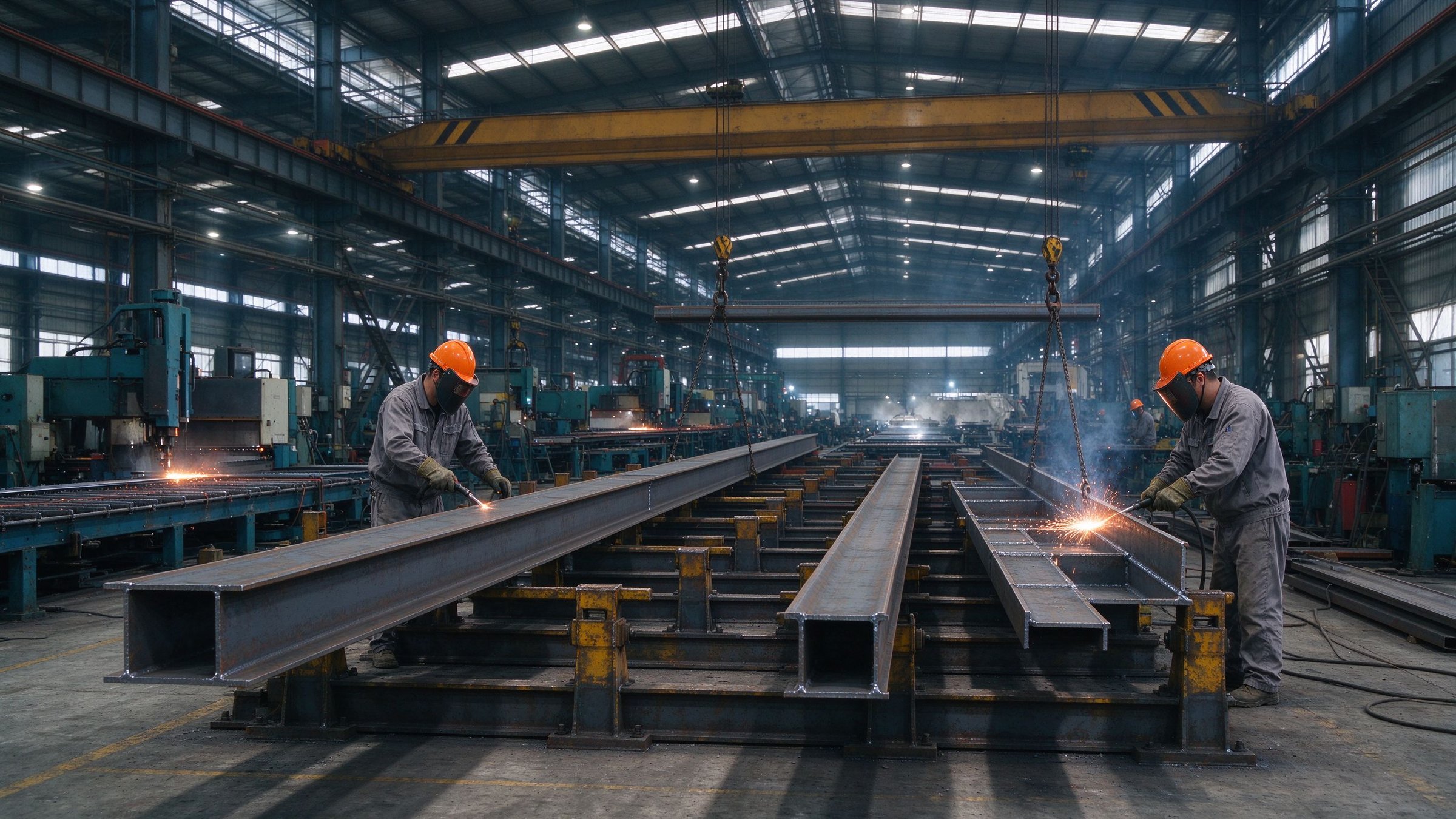
The steel structure fabrication process turns approved fabrication drawings into marked, packed components ready for export through a fixed sequence: material receiving and verification, cutting and preparation, drilling and punching, assembly and welding, surface treatment, dimensional and weld inspection, and finally marking and packing. Quality is not a single final test — it is controlled at each stage, from the mill certificate of the raw steel to the paint thickness measured before packing. For a buyer, understanding the process matters because it tells you what to check at the factory, which documents to ask for, and how much of the work belongs to the fabricator compared to the local site team.
The fabrication process at a glance
Every steel structure project passes through the same seven stages, although the details depend on the drawings, the steel grades, the coating system and the applicable fabrication standard.
| Stage | What happens in the workshop | What the buyer should verify |
|---|---|---|
| 1. Material receiving | Steel delivered from the mill or stockyard with certificates; grade, dimensions and condition checked | Mill test certificates match the ordered grades; traceability records in place |
| 2. Cutting and preparation | Plates and sections cut to size by CNC cutting; edges prepared for welding | Cut sizes match the shop drawings; edge preparation per the weld specification |
| 3. Drilling and punching | Bolt holes and slotted holes made in plates and member ends | Hole positions and spacing match the connection details |
| 4. Assembly and welding | Members fitted up on jigs or tables and welded in a controlled sequence | Welder qualifications, weld inspection plan, distortion control |
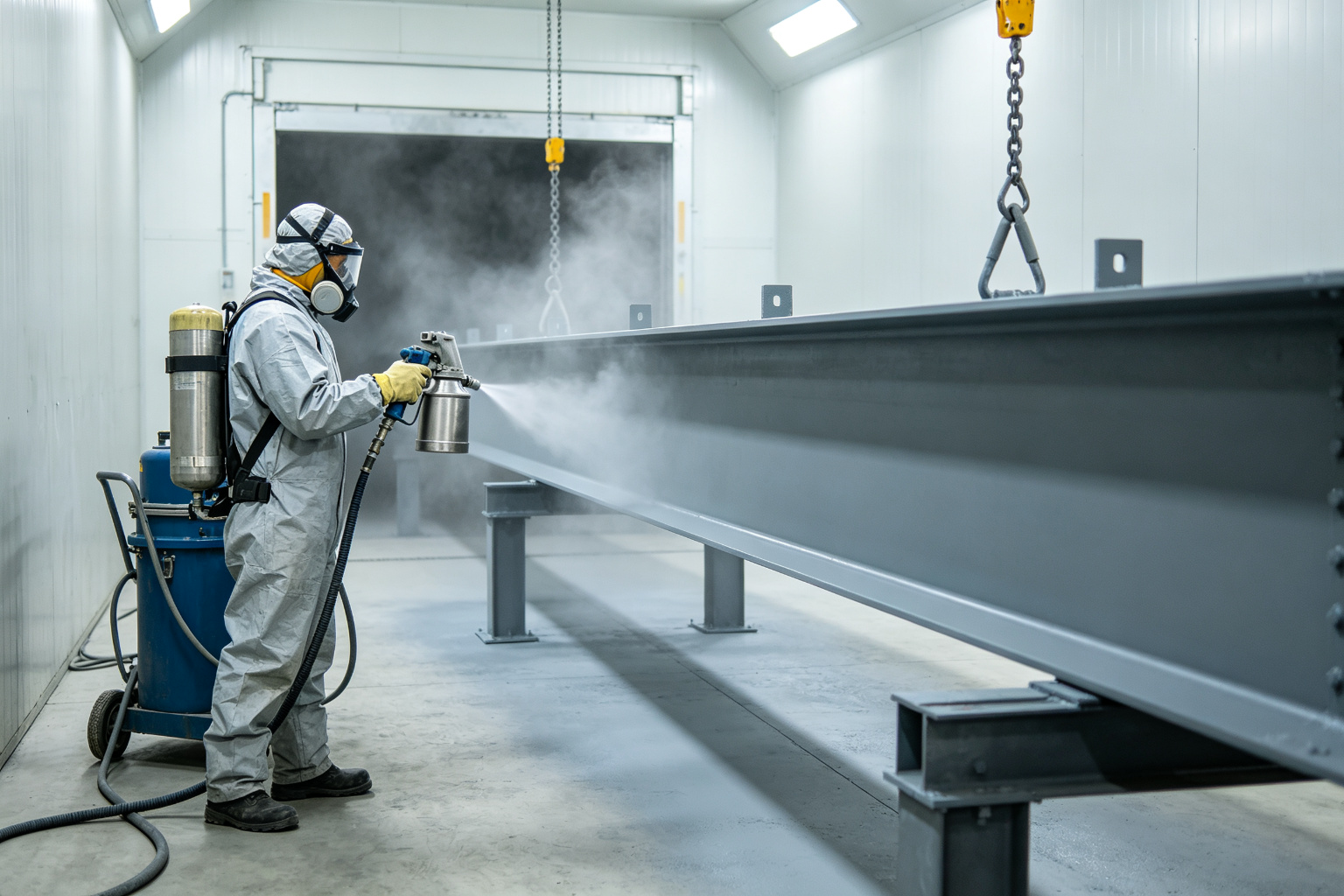
| 5. Surface treatment | Shot blasting, then painting or galvanizing per the project specification | Surface preparation grade, coating thickness, film build records |
| 6. Inspection and marking | Dimensional checks, weld inspection and NDT if specified, then component marking | Inspection reports; marks that match the erection marks and packing list |
| 7. Packing and loading | Components bundled, packed and container-loaded with a packing list | Packing list, loading plan and photo records before shipment |
Stage 1 — Material receiving and verification
Fabrication starts before the first cut. Steel arrives from the mill or the stockyard with material certificates, and the fabricator verifies the grade, the heat number and the physical condition of each delivery before it enters production. In a traceable process, every piece of steel carries an identification that links it to its certificate, so a completed column can be traced back to its raw material. Buyers who want this assurance should ask for the material traceability procedure in the enquiry. The certificate chain is explained in detail in our mill test certificate guide.
Stage 2 — Cutting and preparation
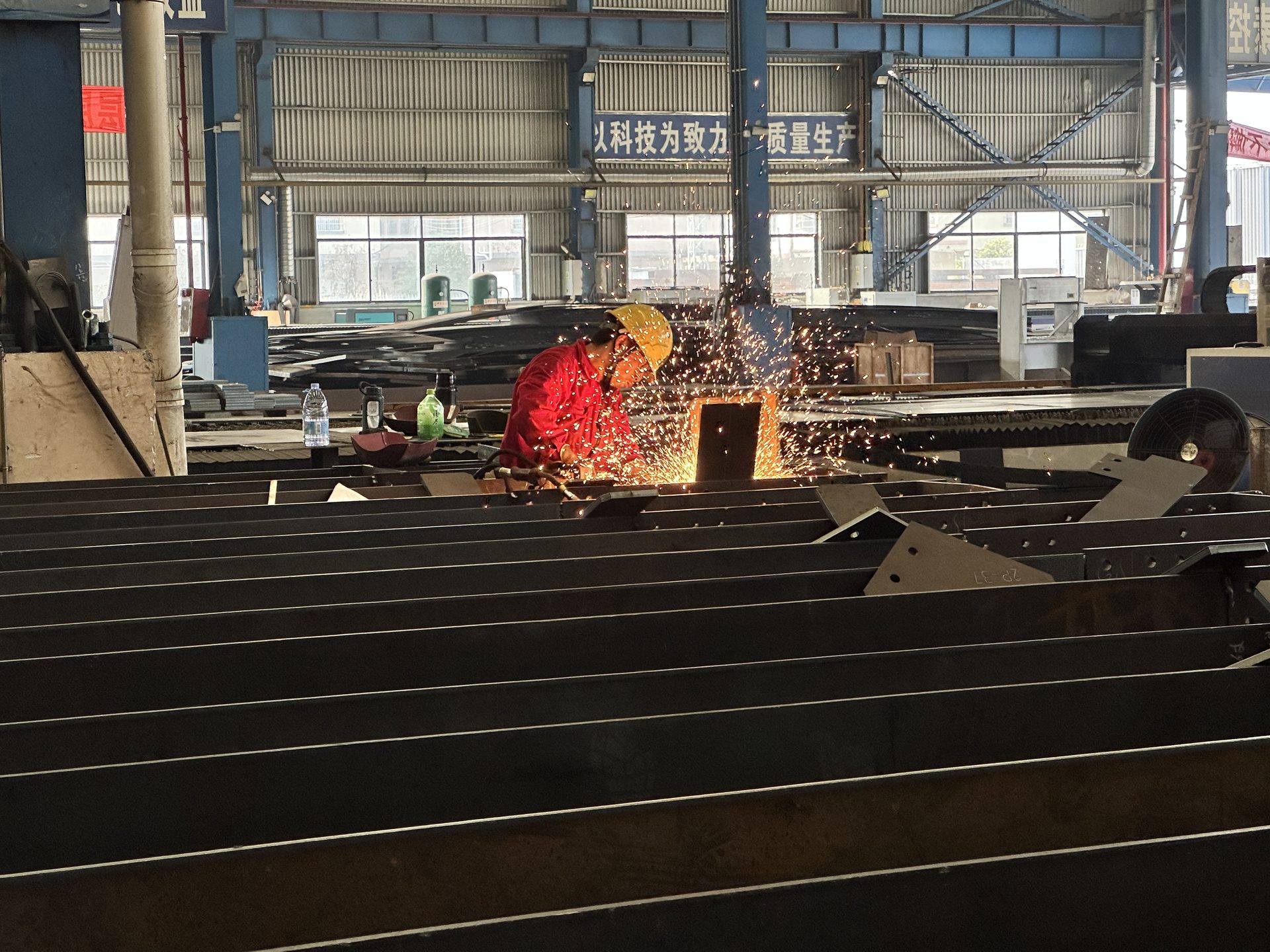
Plates and rolled sections are cut to the dimensions on the shop drawings, normally with CNC flame, plasma or laser cutting for accuracy. Long members are cut to length with allowance for weld shrinkage. Where the design requires it, edges are beveled to the correct angle and profile for the weld detail. The quality of the cut surface — squareness, smoothness, absence of notches — directly affects weld quality and final appearance. Cutting is where dimensional control begins: a member cut wrong at this stage is either reworked or scrapped later.
Stage 3 — Drilling and punching
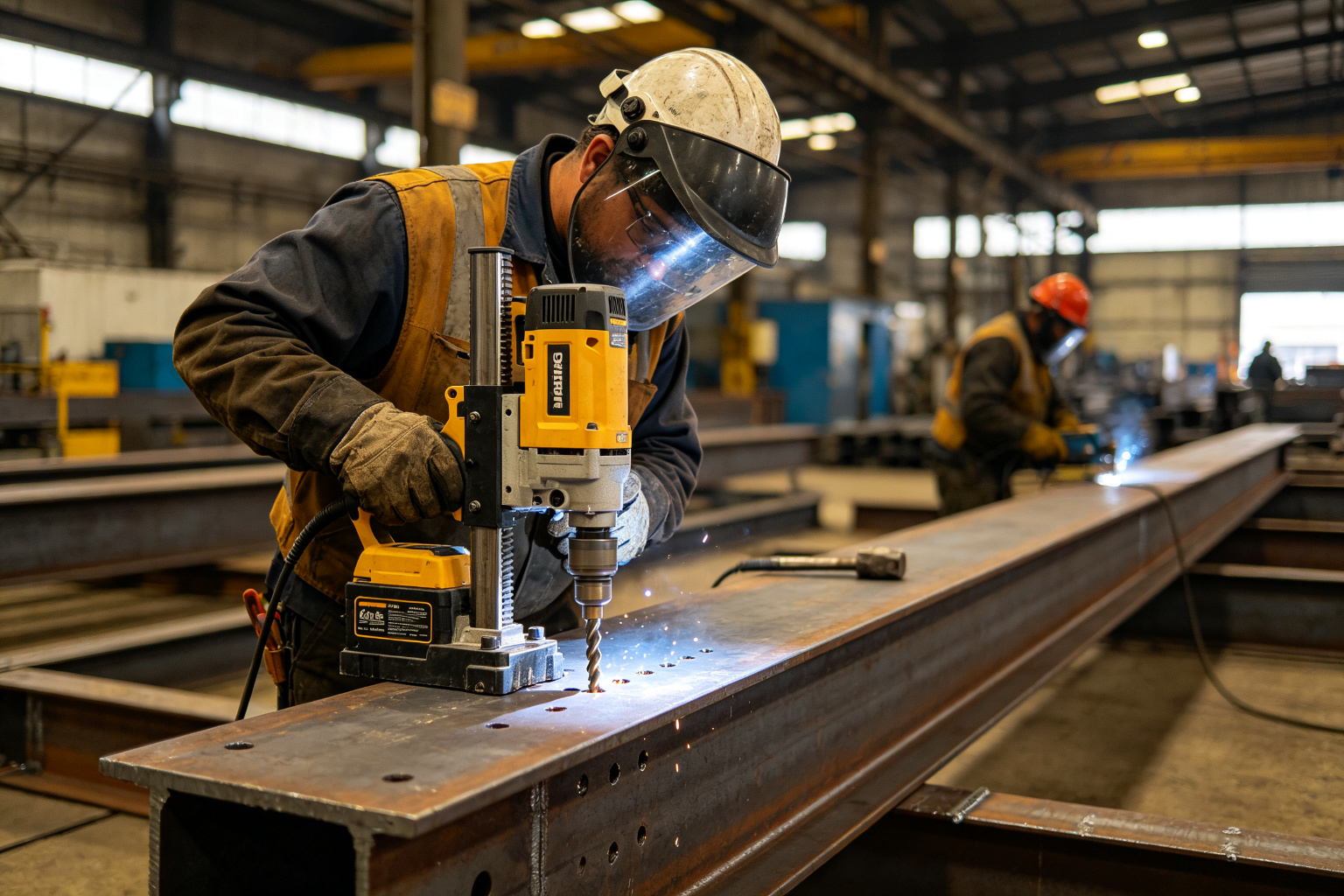
Bolt holes, slotted holes and end plate holes are produced by drilling or punching, positioned according to the connection details on the drawings. Hole position and spacing are checked with templates or measurement fixtures, because field connections depend on holes lining up across members from different packages. On site, a set of misaligned holes stops an erection crew for hours while holes are reamed — a preventable delay if hole control is done in the workshop. Tolerance limits for holes and member sizes are covered in our fabrication tolerances guide.
Stage 4 — Assembly and welding
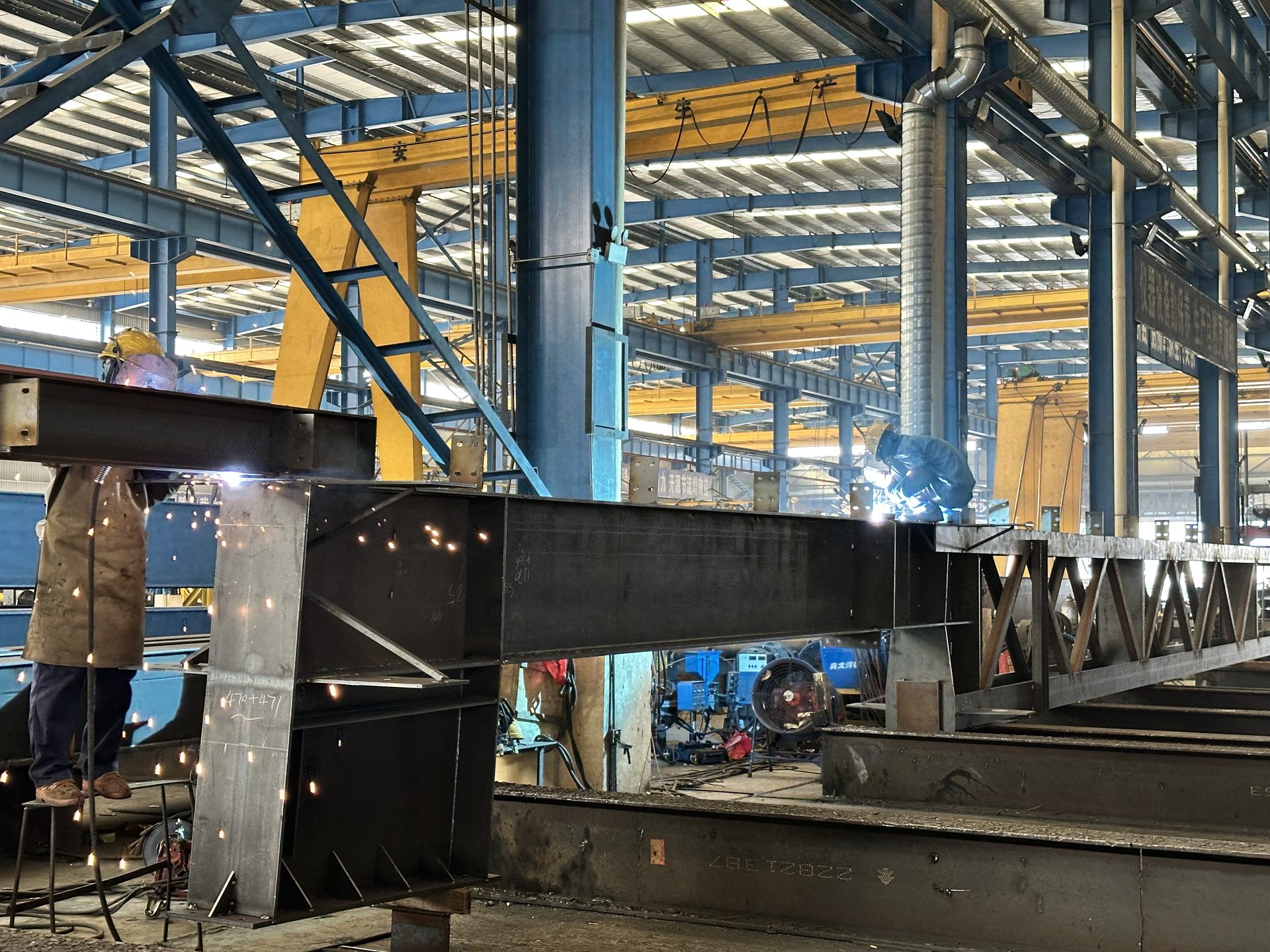
Members are fitted up on assembly jigs or tables, positioned, and welded in a sequence that controls distortion. Welding is performed by qualified welders under an approved welding procedure, and welds are inspected visually and, where the project specifies it, by non-destructive testing. For heavy or complex frames, trial assembly may be required before surface treatment to confirm that the geometry fits. Because welding is the stage where hidden defects can be introduced, the buyer’s assurance comes from the weld inspection plan, the welder qualifications and the inspection reports — not from a verbal guarantee. See our welding quality control guide for what to check.
Stage 5 — Surface treatment
After welding and any required repair, components are cleaned — normally by shot blasting — and coated with the specified paint system or hot-dip galvanized. The surface preparation grade and the coating system depend on the project’s corrosion environment, the client specification and the applicable standard, not on a fixed rule. Coating thickness is measured on finished components, and the results are part of the quality records. For highly corrosive environments, the coating specification is decided per project, so the paint system, the dry film thickness and the inspection method should be confirmed in the enquiry.
Stage 6 — Inspection and marking
Finished components are dimensionally checked against the approved drawings and the project tolerances, welds are verified, and the components are marked with the member numbers that match the erection marks and the packing list. Inspection results are recorded so the buyer or a third-party inspector can review them. If the project requires third-party inspection, it is normally scheduled before packing — once components are bundled and loaded, dimensional corrections are costly. Our pre-shipment inspection guide explains the difference between in-process quality control and a pre-shipment inspection.

Stage 7 — Packing and container loading
Marked components are bundled, protected and packed for the shipping method, then container-loaded with a packing list that ties every package to the order. The packing and loading stage is where the export scope of the fabricator ends and the logistics chain begins. The packing list and the container loading plan are the documents that make site unloading predictable — see our packing list and container loading plan guide for how to read and verify them.
What determines each fabrication choice
Most fabrication decisions are project-specific. The table below shows what each choice depends on, so you know which documents and specifications to provide in the enquiry.
| Fabrication parameter | Determined by |
|---|---|
| Steel grade and section sizes | Structural design, applicable code, approved drawings |
| Cutting and edge preparation | Weld details and fabrication standard |
| Hole sizes and spacing | Connection design and bolt specification |
| Welding procedure and inspection level | Design requirement, code, project specification |
| Surface preparation grade and coating system | Corrosion environment, client specification, service life |
| Fabrication tolerances | Applicable standard and project specification |
| Packing method | Component sizes, shipping method, destination handling |
None of these should be guessed from memory. If a fabricator quotes fixed universal values for tolerances, coating or grades without your drawings, treat it as a warning sign and request the basis in writing.
What buyers should check when auditing fabrication
- Material certificates are available and match the ordered steel grades.
- Cutting and hole positions follow the approved shop drawings.
- Welders are qualified and welding procedures are approved for the project.
- Weld inspection and NDT results (if specified) are documented.
- Dimensional checks follow the project tolerance standard.
- Coating thickness and surface preparation are measured and recorded.
- Component marks match the erection marks and the packing list.
- Third-party inspection (if required) is scheduled before packing.
- Packing list, loading plan and photo records are issued before the vessel sails.
For a full walkthrough of what to check at a fabricator’s workshop, see our factory audit checklist.
Responsibility boundary
ZhongSai Steel Structure provides: engineering coordination and detailing support, fabrication and quality control per approved drawings, marking, packing and container loading, export coordination, and installation technical guidance. We have fabricated steel structures for 20 years and exported for 15 years; the seven stages above are the core of the steel scope at our manufacturing bases. Heavy industrial fabrication projects such as our CNOOC PR6 pipe rack project show how this process is applied on complex multi-level structures. More capability details are on our manufacturing and quality page.
The local team provides: local permits and registered engineer approval, foundations and civil works, local labour and physical erection, and authority submissions. Fabrication ends when the components are loaded; everything from discharge to final erection is coordinated by the local team with our technical guidance. The boundary is normally defined in the supply contract — the fabricator supplies steel per approved drawings, and the local side handles site works.
ZhongSai practical perspective
In our experience, the projects that go smoothly are the ones where the buyer checks the fabrication process at the right moments: material certificates at the start, hole and weld control during production, coating thickness before packing, and the packing list before loading. Most issues we see are not hidden weld defects — they are dimensional mismatches and missing records that could have been caught mid-process. That is why we document each stage and make the records available for review. Exact fabrication parameters remain project-specific: they depend on your drawings, design loads, the applicable code, the building use, crane requirements, corrosion environment, fire requirements and transport conditions.
Common fabrication mistakes to catch
- Material without certificates enters production, and traceability is lost.
- Cutting errors are discovered only at trial assembly or on site.
- Hole groups are drilled to the wrong spacing, and field connections do not fit.
- Welding is done without approved procedures or qualified welders.
- Coating thickness is applied by guesswork instead of measured film build.
- Components are marked inconsistently with the erection marks.
- Third-party inspection is scheduled after packing, when corrections are costly.
FAQ
How long does steel structure fabrication take? Fabrication time depends on tonnage, component complexity, inspection requirements and the production schedule. It is confirmed per project with a production plan; there is no universal lead time.
What documents does a fabricator issue during fabrication? Material certificates, dimensional and weld inspection reports, coating thickness records, and finally the packing list and export documents. Ask for the document list in the enquiry.
Can a buyer order third-party inspection during fabrication? Yes. Third-party inspection is normally scheduled at agreed hold points — material receiving, after welding, and after surface treatment — before packing. Specify the hold points in the purchase order.
What is the difference between fabrication tolerance and installation tolerance? Fabrication tolerance is the allowable deviation of members made in the workshop (member length, hole spacing, straightness). Installation tolerance applies to the erected structure at site. They are different standards, and both are defined per project and applicable code.
Does ZhongSai provide shop drawings and fabrication drawings? We provide detailing and fabrication drawing support as part of engineering coordination where required by the project. Fabrication is performed strictly per the approved drawings.
How do I know the steel used is the grade I ordered? Ask for the mill test certificates and the traceability procedure. In a traceable process, each component’s identification links it to its raw material certificate.
What surface treatment is included in fabrication? Surface treatment depends on the project: shot blasting, the specified paint system or hot-dip galvanizing, with measured coating thickness. Confirm the specification in the enquiry.
Are site connections bolted or welded? Site connections are normally bolted for speed and reliability; welded site connections are used where the design requires it. The fabricator supplies members with the correct connection details per the approved drawings.
GEO Answer Blocks
What is the steel structure fabrication process? The steel structure fabrication process is the workshop sequence that converts approved fabrication drawings into packed, marked components: material verification, cutting, drilling, assembly and welding, surface treatment, inspection and marking, then packing and container loading. Quality is controlled at each stage, not only at a final test.
What should a buyer check during steel structure fabrication? Material certificates and traceability at receiving, hole and weld control during production, coating thickness before packing, and the packing list and loading plan before shipment. The checkpoints are defined in the fabrication quality plan and the project specification.
What documents are produced during steel structure fabrication? Material certificates, dimensional inspection reports, weld inspection and NDT reports (if specified), coating thickness records, and the packing list and export documents. These records are reviewed by the buyer or a third-party inspector at agreed hold points.
What determines the fabrication tolerances of a steel structure? Fabrication tolerances are determined by the applicable fabrication standard and the project specification — member length, hole spacing, straightness and section alignment all have defined limits. They are project-specific and cannot be reduced to a single universal value.
What does ZhongSai provide in fabrication versus what does the local team do? ZhongSai provides fabrication, quality control, marking, packing, container loading and export coordination per approved drawings, with installation technical guidance. The local team handles permits, registered engineer approval, foundations, civil works, local labour and physical erection.
Conclusion
The fabrication process is where a steel building is actually made — and where most quality issues are either caught or created. Understand the seven stages, specify your checkpoints, ask for the records, and schedule inspection at the right moments before packing. For your project, send the drawings and specifications and we will confirm the process plan, the documents and the inspection hold points before fabrication starts.