
Steel Structure Pre-Shipment Inspection: What to Check Before Your Order Leaves the Factory
Pre-shipment inspection is the final quality check on steel structure components before packing and export. It verifies that fabricated members match the approved shop drawings — dimensions, welds, surface treatment, bolt holes, markings and quantities — against the agreed standard (GB 50205, AISC or EN 1090-2), and ends with a written inspection report.

Pre-shipment inspection is the final quality check performed on steel structure components before they are packed and loaded for export. It verifies that fabricated members match the approved shop drawings — dimensions, weld quality, surface treatment, bolt holes, markings and quantities — against the agreed standard, usually GB 50205, AISC or EN 1090-2. The inspection is normally witnessed by the buyer’s engineer or a third-party inspector at the fabricator’s workshop, and it ends with a written inspection report. It is the last point where a deviation can be corrected before freight, customs clearance and site erection make rework expensive.
This guide explains what a pre-shipment inspection covers, who performs it, how it relates to earlier quality control, what documents you receive, and how to use the inspection result to protect your project.
Part 1: What pre-shipment inspection is and why it matters
A pre-shipment inspection is a point-in-time verification of the finished members, normally carried out when fabrication is complete and before packing begins. It is different from the quality control the fabricator runs continuously during production. In-process QC — material verification, welding control, dimensional checks during assembly — prevents defects from being built in; a pre-shipment inspection confirms that the completed lot matches what was ordered.
Why it matters for an international buyer:
- It is the last controllable moment. Once members are packed into a container, a wrong dimension, missing bolt hole or damaged coating is expensive to fix and delays the whole schedule.
- It gives you leverage before payment. Inspection is typically done before the final payment milestone, so issues can be corrected by the fabricator without dispute.
- It protects the site schedule. Members that pass inspection are far less likely to cause problems during erection, when local labour, cranes and engineers are already on site.
- It creates a record. The inspection report becomes part of the handover documentation, useful for customs, insurance and later claims if anything is found damaged on arrival.
Part 2: What is actually checked
The scope of a pre-shipment inspection is defined by the approved shop drawings, the fabrication specification and the applicable standard. In practice, the check covers the following areas.
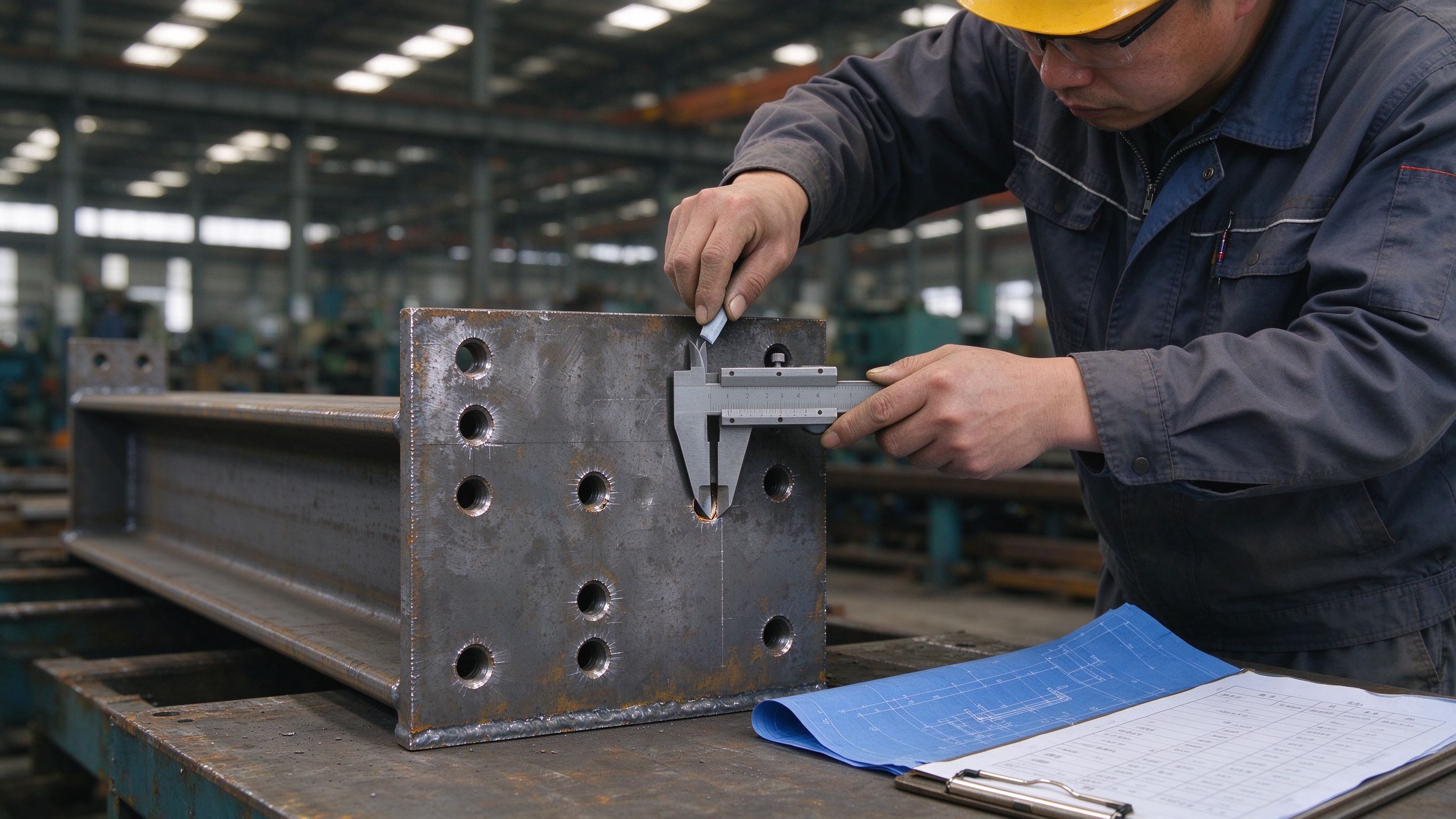
Dimensional accuracy. Each member is checked against the shop drawing: overall length, cross-section dimensions, squareness, camber if specified, and the position and size of bolt holes and end-plate holes. This is where the agreed fabrication tolerances — GB 50205, the AISC Code of Standard Practice or EN 1090-2, depending on the project — are applied. For a full guide on tolerance categories and how they affect erection, see our fabrication tolerances guide.
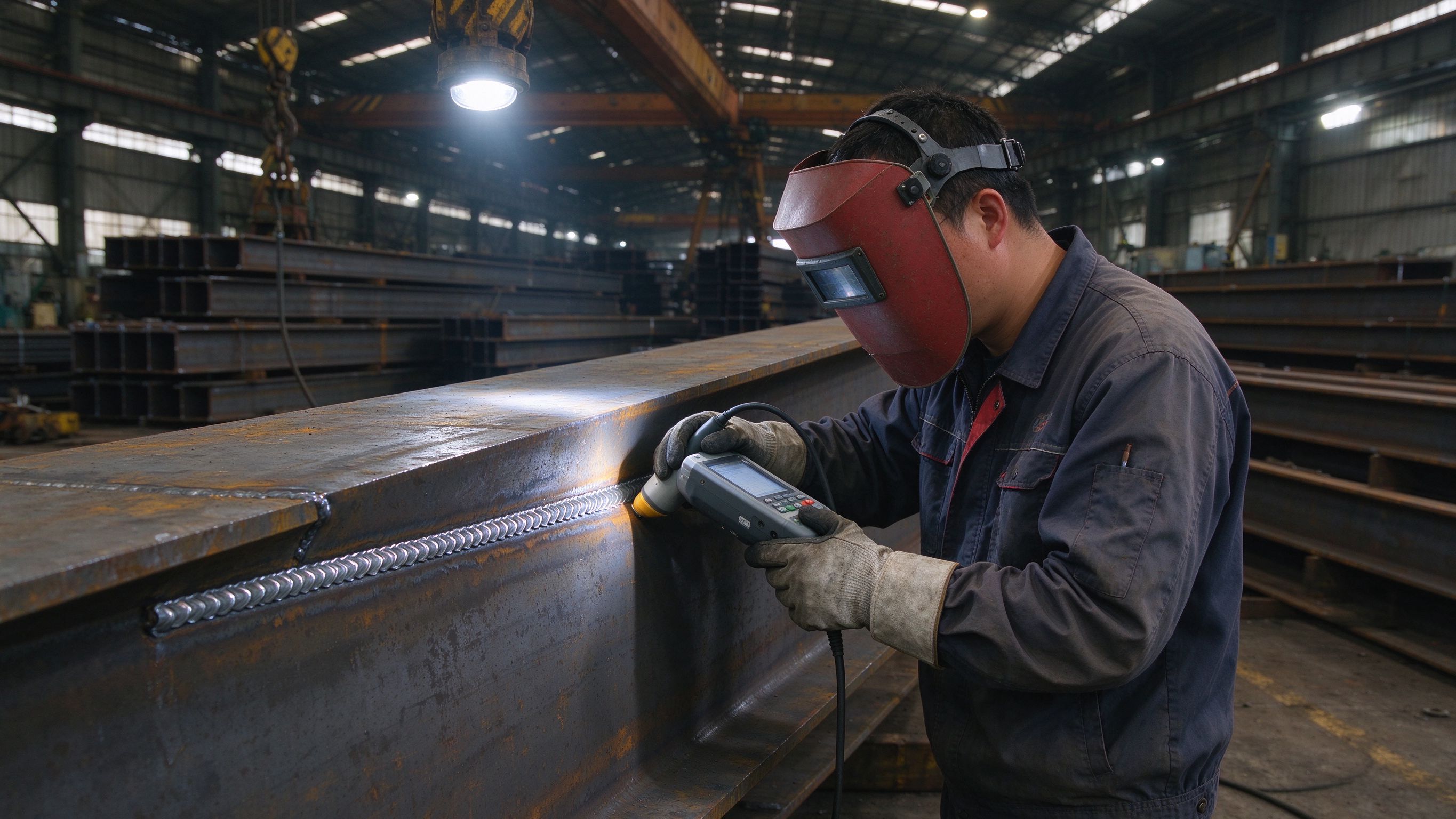
Weld quality. Visible weld appearance, weld size and, where specified, the results of non-destructive testing such as ultrasonic or magnetic particle inspection are reviewed. Weld acceptance criteria come from the design specification and the applicable standard. The fabricator should be able to show the welding procedure qualification and welder records behind the work. Our welding quality control guide explains how weld quality is managed during production.
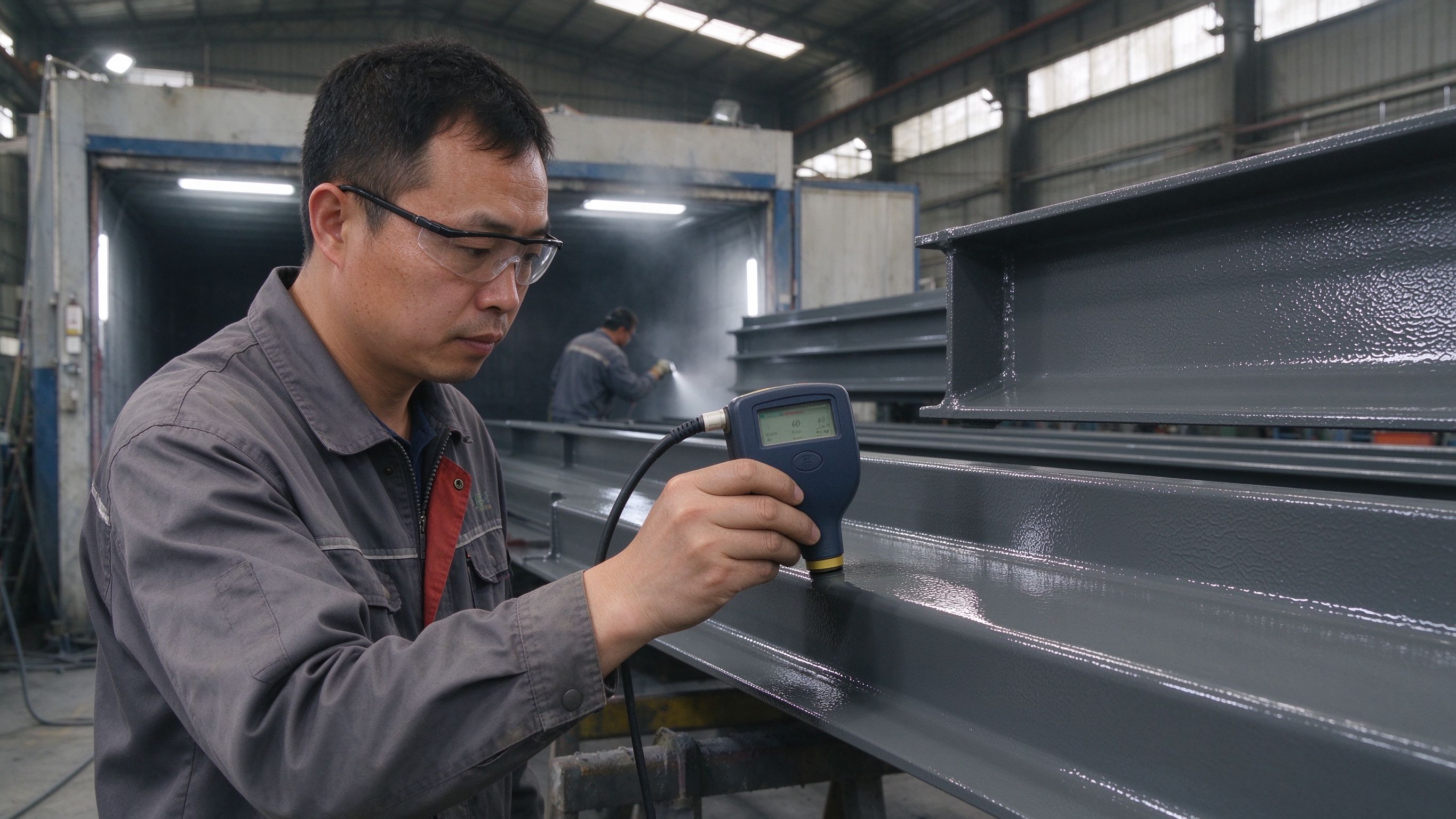
Surface treatment and coating. The inspector verifies surface preparation grade (for example Sa2.5 before coating), the applied coating system, and dry film thickness against the specification. Coating defects such as runs, pinholes or damage in handling are noted. See our surface treatment and coating guide for the full picture of coating systems and inspection points.
Marking and identification. Members should carry the erection marks and any required part numbers matching the shop drawings and the erection plan, so the site team can identify each piece. Marking standards are covered in our erection marks guide. If markings are unclear, site erection slows down immediately.
Quantities and completeness. The inspector or the buyer’s agent confirms that the number of members, bolts, fittings and loose parts matches the packing list and the approved fabrication scope. Missing small parts are a common cause of site delay, so the loose parts list deserves the same attention as the main members.
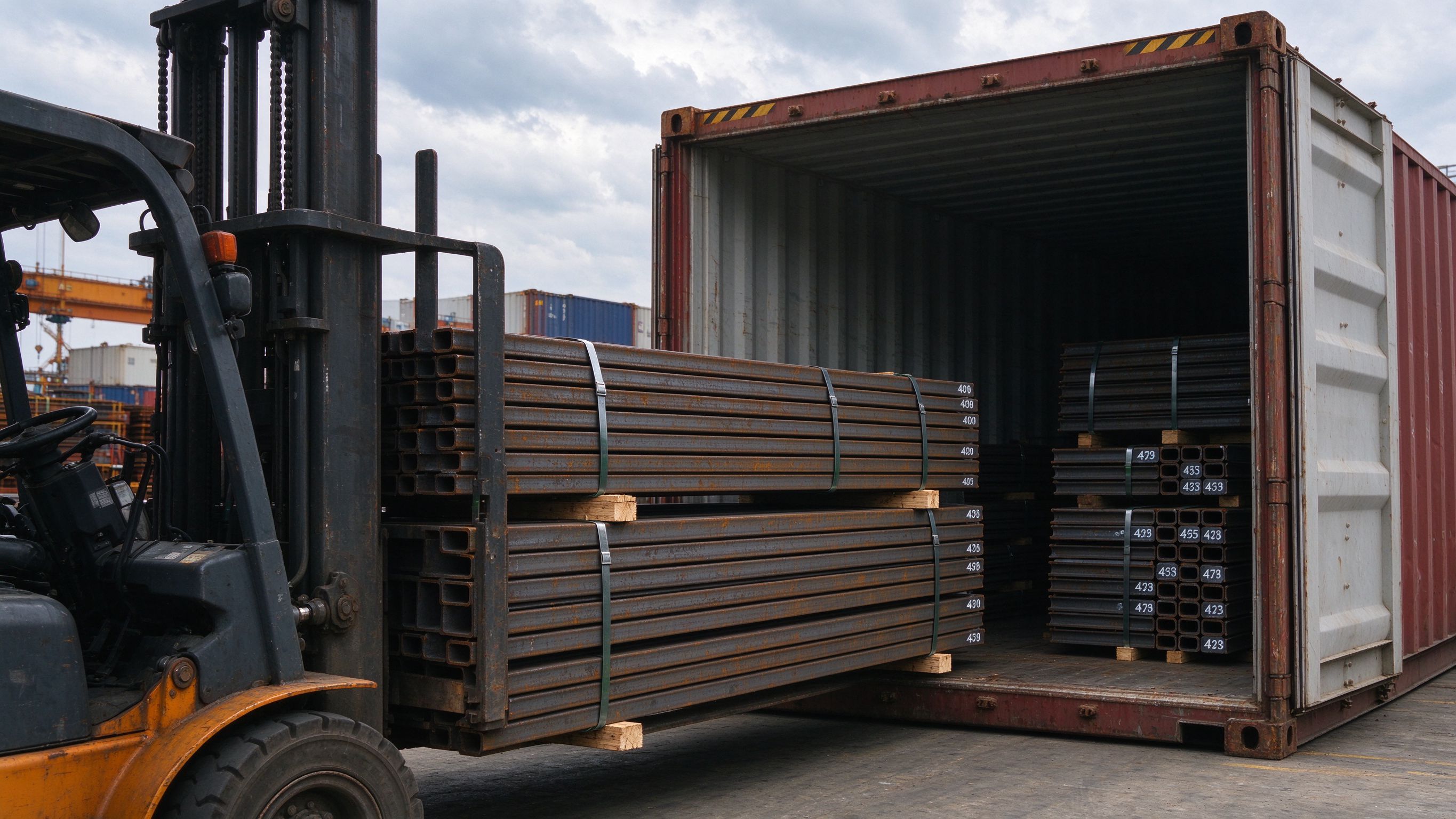
Packing condition. Before loading, the inspector checks that members are correctly bundled, protected with dunnage, and packed in a way that survives sea transport — this is the boundary between inspection and packing. Packing methods, container loading and the documents that travel with the shipment are covered in our packing and export guide.
Part 3: Who performs the inspection
A pre-shipment inspection can be carried out in three ways:
- The fabricator’s own QC team, as part of the standard handover procedure. This confirms the fabricator’s own records but is not independent.
- A third-party inspection company, engaged by the buyer, such as SGS, Bureau Veritas, TÜV or a local agency familiar with steel structures. This is the most common choice for international projects and gives an independent record.
- The buyer’s engineer, visiting the workshop or attending remotely by video. This is common when the buyer already has an engineer familiar with the project drawings.
The inspection scope, the sample size (full check or sampling), the acceptance standard and the report format should be agreed before fabrication starts, not at the inspection day. For sampling, buyer and fabricator should agree which members are critical and must be checked 100%, versus those that can be sampled.
Part 4: How inspection relates to earlier quality control
A pre-shipment inspection is the final gate, but it is not the only control. For a fabricated steel structure, the quality chain normally looks like this:
- Material verification — mill certificates matched to the specified steel grade.
- In-process fabrication checks — cutting, drilling, assembly and welding control.
- Fit-up and dimensional checks after welding, before surface treatment.
- Surface treatment inspection — preparation grade and coating application.
- Pre-shipment inspection — the completed members, markings and packing.
If earlier stages were managed well, the pre-shipment inspection is usually a confirmation. If the buyer has not seen any earlier control, the pre-shipment inspection becomes the single point of evidence, which makes agreeing the scope beforehand even more important. The factory audit checklist helps you assess a fabricator’s overall quality system before you commit.
Part 5: Documents you should receive
After a successful inspection, the buyer should receive, or be able to request:
- The inspection report, listing items checked, measurements taken, results and any non-conformities.
- Non-conformity and correction records, if any items were rejected and reworked.
- Material certificates (mill certificates) for the steel grades used.
- Welding records, if required by the specification.
- The packing list, which travels with the shipment and is used for customs clearance.
The exact document set depends on the contract and the destination country. The RFQ and quotation checklist covers which documents to agree at the quotation stage.
Part 6: What to do when inspection finds a problem
When a non-conformity is found, the typical sequence is:
- The inspector records it and it is classified as critical or minor.
- The fabricator proposes a correction (rework, replacement or an agreed deviation if the deviation does not affect structural performance and the engineer accepts it).
- The corrected items are re-inspected before packing.
- Only after clearance is the member released for packing and loading.
The contract should state who decides on deviations and what happens if a critical non-conformity is not corrected within the agreed time. This is normally defined in the technical agreement and the commercial contract before production.
FAQ
Should I always hire a third-party inspection company? Not always, but for most international projects it is worth it. A third-party report is independent evidence, it protects both sides, and it is often required by the buyer’s bank or insurance if the shipment is large. For repeat orders with a fabricator you know well, a factory inspection report plus your own engineer’s video attendance may be enough.
Can the inspection be done remotely by video? Yes, for many standard checks such as markings, dimensions, quantities and coating appearance, a live video walkthrough with the fabricator’s QC is practical. Checks that need calibrated instruments — for example ultrasonic weld testing or dry film thickness — are better done by an inspector physically present, or by the fabricator’s own qualified technician with the calibration certificate shared in advance.
What standard is the inspection based on? The agreed standard for the project, typically GB 50205 in China, the AISC Code of Standard Practice in North America, or EN 1090-2 in Europe. The fabrication specification and the approved shop drawings define the specific acceptance values. If no standard is agreed, the inspection has no firm basis.
Does inspection guarantee that everything will fit on site? No. Inspection confirms the members match the drawings and the agreed tolerances at the time of inspection. Site fit also depends on foundations, anchor bolt accuracy, erection sequence and the handling of members after loading. But a properly scoped pre-shipment inspection removes most fabrication-side causes of site problems.
Who pays for the inspection? This is a commercial term. Third-party inspection is often paid by the buyer, with the fabricator providing access, the inspection area, and the necessary lifting and measuring support. Some contracts include a second inspection at the fabricator’s cost if the first one fails on critical items.
What should I prepare before the inspection day? Send the fabricator the inspection scope, the acceptance standard, the names of the critical members, the sample size, and who will attend. Confirm that the approved shop drawings and the latest revision are the ones being inspected. A clear scope sent in advance makes the inspection faster and reduces the chance of a dispute on the day.
CTA
If you are planning a steel structure project and want to control quality from the drawing stage to the pre-shipment inspection, send us your project drawings and requirements. We will confirm the fabrication scope, the inspection points and the documentation set before production starts.
Send Project Drawings → Contact ZhongSai