Crane Rail Installation: Base Plate Grouting, Alignment and Tolerances
A crane rail is not a bar bolted onto a beam. The rail geometry comes from the crane supplier, the base plate elevation comes from the surveyed runway beam, and the grout under that plate is what turns two separate steel surfaces into one continuous support.
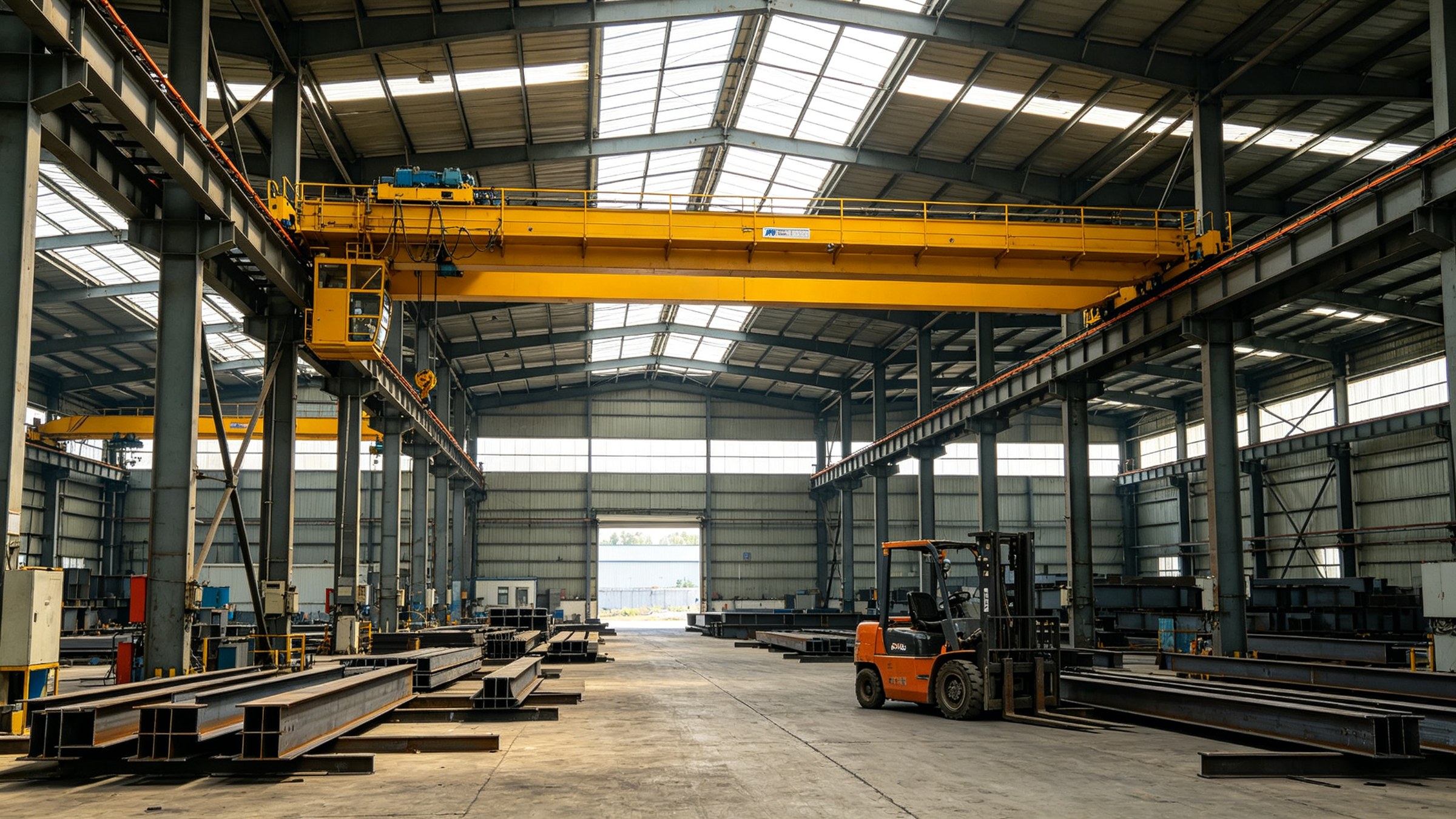
Crane rail installation is decided in three places, not one. The crane supplier fixes the rail section, the gauge and the installation tolerances. The steel fabricator fixes the runway beam elevation, the bracket position and the base plate detail. The site team fixes the surveyed level of the beam top flange, the grout under the base plate and the final alignment record. If any of those three is treated as “someone else’s scope”, the crane will bump, the rail welds will crack, or the rail simply will not sit flat on the plate. This guide sets out the sequence, the grouting method and the checks that have to be signed before the crane is commissioned.
What the rail package actually contains
A crane rail is a system, and buyers who price it as “rail per metre” usually discover the missing items during erection.
| Item | Function | Normally supplied by |
|---|---|---|
| Rail section | Carries the crane wheel loads and guides the wheel flange | Crane manufacturer, or specified by them |
| Rail base plate / sole plate | Spreads wheel load into the runway beam top flange and gives a flat, adjustable seat | Steel fabricator, to the crane supplier’s detail |
| Rail clips or fastenings | Hold the rail laterally and resist creep along the runway | Crane manufacturer or rail supplier |
| Shim packs | Set the base plate to the surveyed elevation before grouting | Site team |
| Grout | Fills the gap between base plate and beam flange so load is transferred over the whole plate, not at shim points | Site team, to a specified product |
| Anchor bolts or welded studs | Connect the base plate to the runway beam | Steel fabricator, to the anchor bolt installation standard used on the project |
| End stops | Stop crane travel at the runway ends | Crane manufacturer |
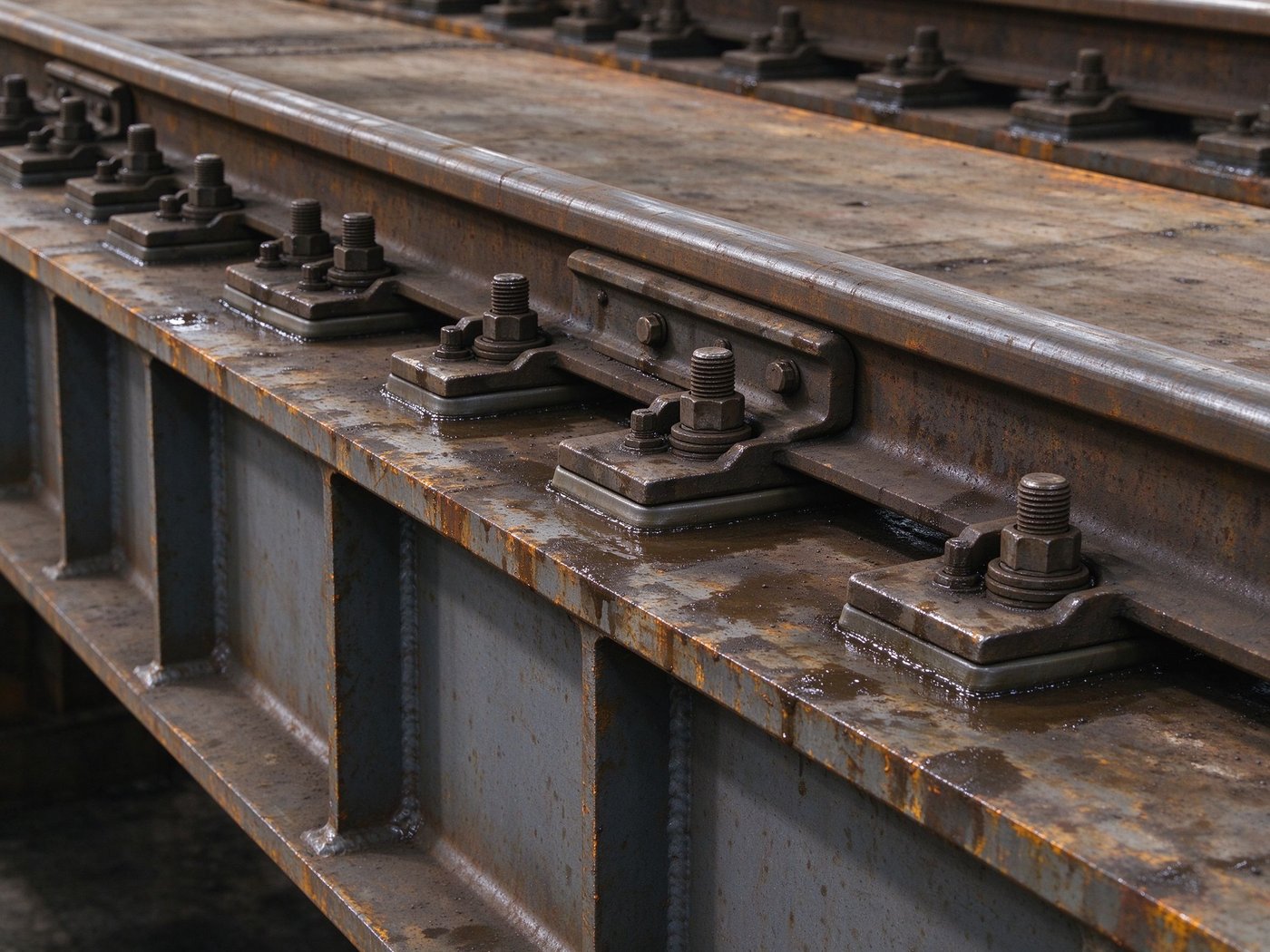
Two practices exist and they are not interchangeable. In one, the base plate is welded to the runway beam top flange and the rail is clipped on top; there is no grout, and the plate elevation is controlled by fabrication. In the other, the base plate is set on shims, levelled against the crane supplier’s tolerance, and then grouted to give continuous bearing. Which practice applies is a specification decision made with the crane supplier and the local engineer, not a preference of the fabricator. Mixing the two on one runway — welding some plates and grouting others — produces a step in the rail line.
Why a rail base plate is grouted at all
A base plate that touches the beam only at shims behaves like a plate on stilts. Wheel loads arrive at discrete points, the plate bends between them, and the connection sees repeated local stress with every crane pass. Grout changes that: it fills the void so the plate bears on the beam over its full area, which lowers local plate bending, reduces vibration and gives the rail a continuous seat.
Grouting also buys adjustment. The runway beam is fabricated to its own tolerance and erected to another; the top flange elevation along a long runway will vary. Shims plus grout let the base plate be brought to a common line before the rail goes down, instead of forcing the rail to follow the beam.
Three conditions make grouting non-negotiable rather than optional:
- The crane supplier’s installation manual requires a grouted base plate, or specifies a maximum gap between plate and beam.
- The runway is long enough that accumulated beam tolerance would exceed the rail straightness tolerance.
- The crane is heavy or high-duty, where local plate bending and fatigue at the fastening matter.
Setting sequence: from crane data to signed alignment
The order below is the one that avoids rework. Each step produces a record the next step depends on.
- Collect the crane supplier’s rail data. Rail section, gauge (centre-to-centre of rails), wheel loads, rail fastening detail, the installation tolerance table and the required base plate detail. Without this, the runway beam cannot be finalised; the wider set of crane parameters and how they change the frame is set out in the overhead crane workshop guide.
- Fix the bracket and beam elevation on the drawing. The bracket elevation sets the rail top level; it has to match the crane supplier’s requirement together with the rail and base plate thickness.
- Fabricate the runway beam and base plates to that elevation, including the anchor bolts or studs and any clip welding. Record actual dimensions at the workshop, not only nominal ones.
- Erect the runway beams and survey the top flange. Measure elevation at a regular spacing along the runway and at every base plate position. This survey is the input to shimming, so it must be taken after erection, not assumed from the drawing.
- Set the base plate on shims to the required elevation and level, then check that the gap between plate and flange is within what the grout product allows. Shim packs are placed near the anchor points, not only at the plate corners.
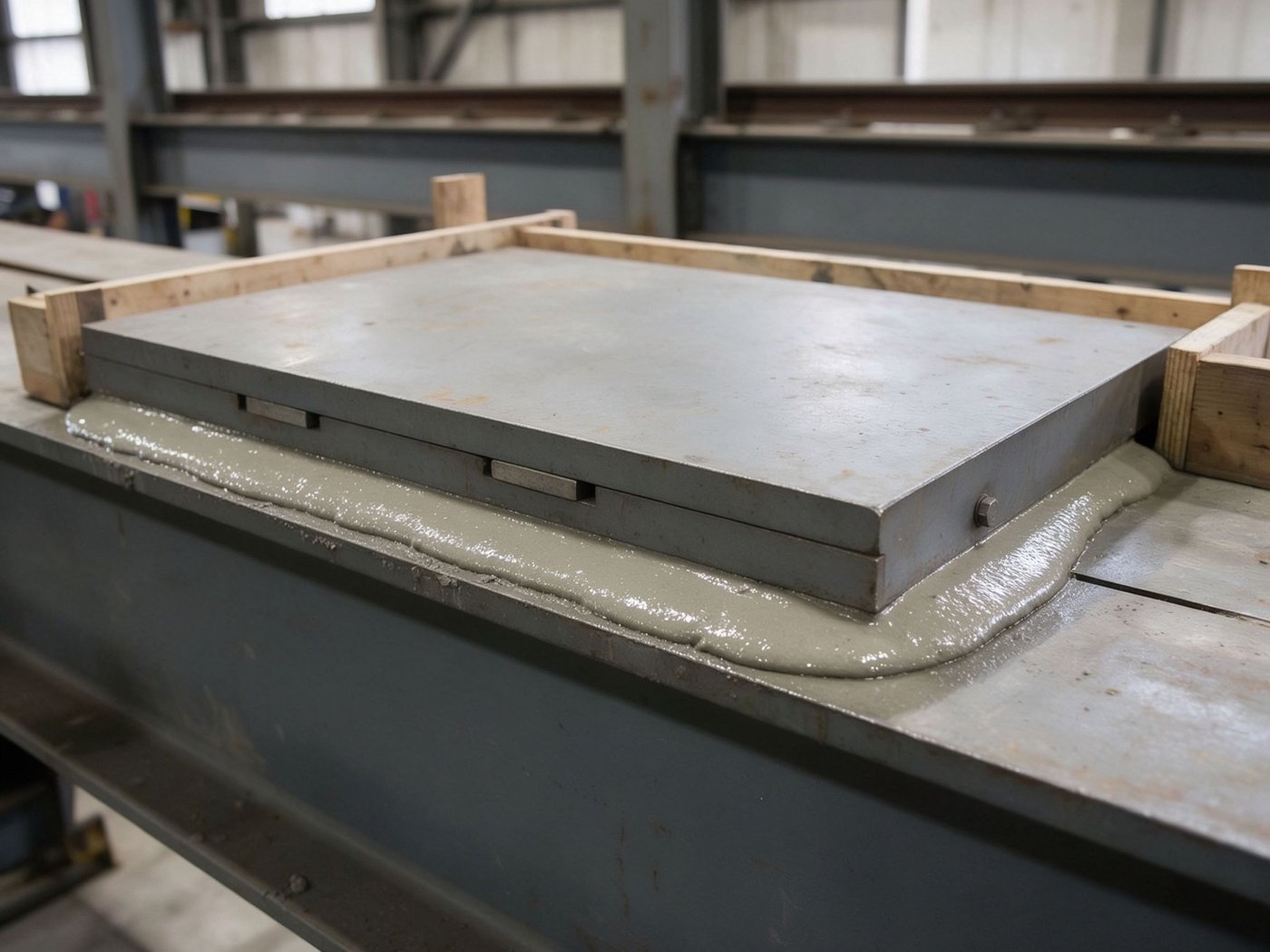
- Install formwork and vents. Grout needs to be contained and air needs somewhere to escape. Missing vent holes are the most common reason a grout bed ends up with voids under the middle of the plate.
- Mix and place the grout to the product’s stated consistency, in one continuous pour per plate where possible, working from one edge so the grout front pushes air out of the vents.
- Cure to the product’s requirement before loading. No rail installation, no clip torque, no crane travel on the plate until the grout has reached its stated strength.
- Install the rail, clips and end stops, then survey the rail line: gauge, straightness, level, joint gaps and the expansion detail at the building joint.
- Hand the alignment record to the crane supplier for commissioning. The crane manufacturer normally checks the rail before the crane is run; the record shortens that check and settles disputes about who moved what.
Choosing and placing the grout
Grout under a rail base plate is not a generic mortar. It is specified as a non-shrink, flowable grout with a stated compressive strength and a stated application thickness range, and the crane supplier or the local engineer normally names the class. What the site team controls is everything that decides whether the product performs:
- Surface preparation. The beam flange and the underside of the plate must be clean, dry and free of oil, loose mill scale and rust. Grout bonds to what it is placed against.
- Gap control. Every grout product has a minimum and maximum application thickness. A gap outside that range either cannot be filled or loses strength; the fix is to change the shim pack, not to add water.
- Consistency. Flowable grout is mixed to the manufacturer’s water ratio and measured, not judged by eye. Extra water for “easier pouring” is the single most common cause of a weak bed.
- Containment and venting. Formwork must be tight enough to hold the grout head, and vents must be at the highest point of the plate so air can leave.
- Temperature and curing. Ambient and surface temperature at the time of placement, and the curing method, follow the product data sheet. Direct sun on a thin plate and rapid drying both reduce the strength reached at the surface.
- Records. Product name, batch, mix ratio, placement date, ambient temperature and curing method belong in the same file as the alignment survey.
Alignment: what is measured, with what, and who signs
Rail alignment is not one number. It is a set of checks, and each one has a source that defines the acceptance value.
| Check | What it controls | Typical instrument | Acceptance value comes from |
|---|---|---|---|
| Rail gauge (span between rail centres) | Wheel flange clearance and crane travel | Steel tape or calibrated gauge | Crane supplier’s installation manual |
| Rail straightness in plan | Crane skew, wheel flange contact, rail side wear | Piano wire or laser line | Crane supplier / local code |
| Rail elevation and level along the runway | Crane bridge level, drive load sharing | Optical level or digital level | Crane supplier / local code |
| Rail joint gap and step | Wheel impact at joints, weld quality | Feeler gauge and straightedge | Rail supplier / crane supplier |
| Expansion detail at building joints | Thermal movement without buckling | Visual and dimensional check against detail | Design drawings and local code |
| Clip seating and fastening torque | Rail creep and lateral restraint | Torque wrench, visual | Fastening supplier’s data |
| Base plate contact after grouting | Load transfer over the full plate | Tap test and visual around plate edges | Specification / engineer’s instruction |
Two points about this table matter more than the numbers. First, the acceptance values are not universal: a crane supplier’s manual and a local code can set different limits for the same check, and the stricter one governs. Second, the survey has to be recorded along the runway, position by position, with the instrument and the date. A single “alignment OK” line in the handover file is worth very little when the crane later bumps at one bay.
Where rail decisions hit the steel package
Rail installation problems usually start on the fabrication drawing, months before anyone pours grout.
| Rail decision | What it changes in the steel package |
|---|---|
| Rail gauge wider or narrower than assumed | Bracket and beam positions, column spacing on the crane bay |
| Higher rail top level | Bracket elevation, column length, sometimes eave height |
| Grouted base plate instead of welded plate | Base plate detail, anchor studs, shim allowance, beam top flange flatness |
| Expansion joint in the rail line | Runway beam joint detail, building expansion joint alignment, end stop positions |
| Higher duty crane class | Beam section, deflection limit, bracket stiffening, local plate thickness |
| End stop and buffer loads | Local stiffening at runway ends and at the column bracket |
The single most expensive version of this is a rail gauge or rail level change after the runway beams are fabricated. It is not a rail problem at that point; it is a beam, bracket and column problem, and the crane delivery date is usually already fixed.
Common mistakes
- Grouting before the beam survey. Grout placed over a beam that was never measured locks in the error; the plate cannot be adjusted afterwards.
- Treating grout as mortar. Ordinary mortar shrinks, cracks and cannot be poured into a thin gap. It fails quietly, and the symptom appears as rail noise months later.
- No vents. Grout flows around a plate and traps air in the middle; the plate sounds hollow when tapped and the bearing area is a fraction of what was designed.
- Too much water. A flowable grout mixed wetter than specified pours easily and reaches a fraction of its stated strength.
- Welding the rail before alignment. Welding the rail line before the survey removes the adjustment the clips and shims were meant to provide.
- Forgetting the expansion detail. A continuous rail welded across a building expansion joint buckles in heat or pulls the fastenings in cold.
- Loading the plate early. Rail installation and crane travel before the grout reaches strength damage a bed that cannot be repaired from underneath.
Responsibility boundary on an export project
Rail installation sits exactly on the line between the steel supplier, the crane manufacturer and the local team. On a typical export package the split is:
| Stage | ZhongSai input | Local party / crane supplier input |
|---|---|---|
| Rail and fastening data | Coordinates the interface, checks that beam detail matches the supplied rail data | Crane supplier provides rail section, gauge, fastening detail and tolerance table |
| Runway beam and base plate fabrication | Fabrication, dimensional check, marking, packing, container loading | — |
| Erection of runway beams | Installation technical guidance, bolt and alignment instructions | Local erection team performs the work |
| Base plate shimming and grouting | Method statement and inspection points in the technical guidance | Local team selects and places grout to the specified class; local engineer accepts |
| Rail installation and alignment survey | Review of the survey record against the crane supplier’s tolerance table | Crane supplier or its appointed installer installs and aligns the rail |
| Crane commissioning | — | Crane supplier commissions; local authority inspection as required |
What this means in practice: the steel package can make rail installation straightforward or impossible, but it does not install the rail. A buyer who expects the fabricator to deliver a commissioned crane has misunderstood the package, and a buyer who lets the crane supplier’s tolerance table arrive after fabrication has removed the fabricator’s ability to comply.

Checklist before the runway is ordered
- Rail section, gauge and rail top elevation received from the crane supplier in writing
- Crane duty class, wheel loads and load diagram received
- Base plate practice agreed: welded plate or shimmed and grouted plate
- Base plate detail, anchor studs and shim allowance shown on the fabrication drawing
- Rail fastening detail (clips, welded clips, or direct fixation) confirmed
- Expansion joint detail agreed between rail line and building joint
- End stop and buffer loads passed to the steel designer
- Grout class, application thickness range and curing requirement named in the specification
- Survey method and recording format agreed, including spacing along the runway
- Acceptance values taken from the crane supplier’s manual and the local code, whichever is stricter
- Inspection and hold points written into the site method statement
- Handover file defined: survey record, grout records, torque records, as-built rail line
FAQ
Does every crane rail need grouting under the base plate? No. If the base plate is welded to the runway beam and the rail is clipped on top, there is no grout and the elevation is controlled by fabrication. Grouting applies where the plate is set on shims and needs continuous bearing, which is usually the case on longer runways, heavier cranes, or where the crane supplier’s manual requires it.
What kind of grout is used under a rail base plate? A non-shrink, flowable grout with a stated compressive strength and a stated application thickness range, named by the crane supplier or the local engineer. Cementitious and epoxy grouts are both used; the choice depends on the gap, the cure time available and the service environment, not on what is available locally.
How is rail alignment checked? Gauge is measured between rail centres, straightness in plan against a wire or laser line, elevation against an optical or digital level, and joint gap and step with a feeler gauge and straightedge. The acceptance values come from the crane supplier’s installation manual and the local code, and the survey is recorded position by position along the runway.
Who installs the crane rail — the steel supplier or the crane maker? Normally the crane manufacturer or its appointed installer, because the rail, fastenings and tolerance table belong to the crane package. The steel supplier delivers the runway beam, brackets and base plate detail that make the rail installable, and provides installation technical guidance for the structure.
Can the rail be installed before the grout has cured? No. Grout has to reach its stated strength before the rail, clips or crane loads are applied. Loading a green grout bed crushes the part that carries the load, and it cannot be repaired from underneath the plate.
What happens if the rail gauge changes after the beams are fabricated? It becomes a structural change: bracket positions, beam spacing and sometimes column spacing on the crane bay all move. That is why the crane supplier’s rail data has to be fixed before the runway beam is detailed, not after the crane arrives on site.
What to send with an enquiry
A crane building cannot be quoted from a lifting capacity alone. Send the crane supplier’s data sheet with rail section, gauge, wheel loads and duty class, the building width and length, the required rail top elevation if it is already fixed, and the local code the project will be checked against. If the crane is not yet selected, send the intended capacity and duty, and the runway can be sized with a stated allowance instead of a guess.
Send project requirements — or review the workshop solution for the wider building scope, and the crane runway beam guide for the beam design that sits under the rail.