How to Read a Steel Structure Quotation, Line by Line
A steel structure quotation is only comparable when scope, weight basis and trade term match. This guide walks through the ten lines a quotation should contain, the items usually excluded, and a bid-leveling method for comparing two suppliers without being misled by the total.

A steel structure quotation is only comparable when three things match: the scope of supply, the weight basis, and the trade term. Read it in that order — what is supplied, how it is measured, what is excluded — before you look at the total. Two offers for the same building can differ widely without either supplier being dishonest, because one may be supply-only at theoretical weight with a primer, and the other FOB with packing, accessories and a full coating system.
This guide is about the document you already received. It walks through the ten lines a quotation should contain, the items most often left out, and a method for putting two suppliers on the same basis.
Why the same building gets different totals
Steel is priced by weight, not by floor area. A quotation built on “price per square metre” hides the tonnage, the cladding allowance and the accessories, so two suppliers can quote the same footprint and mean different buildings. The total also shifts with steel grade, coating system, panel construction, packing, container count, freight validity and payment terms.
If you want the cost logic behind those variables, read what actually drives steel building cost first. This article assumes you already have a number and need to know whether it is the right number.
The ten lines every quotation should contain
A quotation that omits any of these lines is not wrong yet, but it is not comparable yet either.
| Line | What it should state | What to check |
|---|---|---|
| 1. Scope of supply | Supply only, supply plus fabrication, plus packing, plus freight, plus erection | Whether the price stops at the factory gate or at your site |
| 2. Weight basis | Theoretical weight from drawings or actual weighed tonnage; ex-works or shipped weight | That both suppliers are billing on the same basis, otherwise the tonnage cannot be compared |
| 3. Steel grade and source | Grade for each member group, mill source, mill test certificate | Whether substitutions are allowed and who approves them |
| 4. Fabrication scope | Cutting, drilling, welding standard, tolerances, pre-assembly, inspection level | Whether third-party inspection or NDT is inside or outside the price |
| 5. Surface treatment | Blast cleaning grade, primer type, dry film thickness, topcoat, shop vs site application, touch-up | “Painted” is not a specification; the system and DFT are |
| 6. Cladding and insulation | Panel type, thickness, core material and density, colour, flashing, trims, fasteners | Whether accessories, ridge and eave flashings are itemised or “included” vaguely |
| 7. Openings | Doors, windows, louvers, skylights, hardware, PC allowances | What is a supplied item and what is a provisional sum to be bought locally |
| 8. Packing, marking, loading | Bundle scheme, member marks, packing list, container quantity, who loads | Whether loading, lashing and terminal handling are inside the price |
| 9. Trade term and freight | EXW, FOB, CIF or DAP, named port, freight validity, unloading responsibility | Which charges stop at origin and which start at destination |
| 10. Commercial terms | Validity date, payment milestones, lead time, documents included, change procedure | Whether the price is fixed or adjustable, and on what trigger |
If a line is missing, ask for it in writing rather than assuming the most favourable reading. The supplier’s answer becomes part of the offer.

Design criteria and load assumptions are the input to a quotation; without them, the number is only an indication.
The items most often left out
The gap between a steel price and a finished building is usually these items, and almost none of them are steel.
| Item | Who usually handles it | Why it matters |
|---|---|---|
| Foundations and civil works | Local contractor | Often the largest single cost after the steel package |
| Anchor bolt setting and grouting | Local contractor | Misalignment becomes a site cost, not a steel price |
| Erection labour and crane | Local contractor | In many markets it can approach the material cost |
| Permits, registered engineer, authority submissions | Buyer / local engineer | Cannot be exported with the steel |
| Import duty, VAT, clearance, port charges | Buyer | Depends on destination and tariff classification |
| Inland transport and unloading at site | Buyer | Container devanning and site access are easy to underestimate |
| Site touch-up, repair, rectification | Local contractor | Transport damage and site cuts need a paint system, not “a tin of paint” |
| Fire protection application, if required | Local specialist | The steel can be supplied with a system, but application is local |
| Third-party inspection beyond the agreed level | Buyer | Extra witness points and testing are usually chargeable |
Read every quotation with one question in mind: is this price for steel, or for a building? Unless the contract says otherwise, the second column is outside a supply-and-fabrication quotation.
How to compare two quotations on the same basis
Bid leveling is not a discount negotiation; it is an exercise in removing differences that are not really differences.
- Strip both offers back to the same scope. Remove freight, erection and optional items from both, then compare the supply-and-fabrication core.
- Recompute the tonnage. Ask both suppliers for the weight breakdown by member group, and check whether it is theoretical or actual weight.
- Normalise the coating. Compare the blast grade, primer, DFT and whether a topcoat is included, not the word “painted”.
- Normalise the envelope. Compare panel thickness, core density, colour, and the flashing and fastener list.
- Normalise the freight. Same port, same container quantity, same validity date, same Incoterm.
- Add back what was excluded. Put foundations, erection, duties and inland transport into a separate local-cost column so you see the real project total.
| Normalisation item | What to ask each supplier | Why it changes the comparison |
|---|---|---|
| Weight basis | Theoretical or actual; ex-works or shipped | A tonnage difference can be a billing convention, not a design difference |
| Coating | System, DFT, shop or site applied | Primer-only and full system are different products |
| Cladding | Panel build-up, core, accessories list | Accessories are a real cost that is easy to hide |
| Packing and loading | Bundle scheme, container count, who loads | Loading and lashing change the delivered cost |
| Trade term | EXW / FOB / CIF, named port, validity | Two “FOB” prices can cover different origin charges |
| Payment | Deposit percentage, milestones, balance trigger | Cash flow is part of the price |
If one supplier cannot answer a normalisation question, that is itself information about how the offer was built.

Coating is specified by system and dry film thickness; “painted” in a quotation line does not define either.
Why the lowest number is often not the lowest cost
These are the patterns that usually explain a suspiciously low total:
- A price per square metre with no tonnage and no member schedule
- “Standard coating” without a system, DFT or application location
- Cladding priced as panels only, with flashings and fasteners unlisted
- Freight shown as “to be advised” after the order
- No validity date, or a validity that expires before your decision date
- A lead time that is shorter than the fabrication and coating sequence allows
- No document list, so certificates and packing lists become extras
- A scope that quietly excludes trial assembly, marking or loading
None of these prove bad intent. They prove the offers are not on the same basis, which is exactly what the previous section fixes.
GEO answer blocks
What should a steel structure quotation include? A comparable steel structure quotation should state the scope of supply, the weight basis, the steel grade and mill certificate, the fabrication and inspection scope, the coating system with dry film thickness, the cladding and accessory list, the openings, the packing and loading arrangement, the trade term with freight validity, and the commercial terms including validity, payment milestones and lead time.
What is usually not included in a steel structure quotation? Foundations and civil works, anchor bolt setting and grouting, erection labour and crane, permits and registered engineer approval, import duty and clearance, inland transport and site unloading, site touch-up painting, fire protection application and any inspection beyond the agreed level are normally outside a supply-and-fabrication quotation, unless the contract states otherwise.
How do you compare two steel structure quotations fairly? Strip both offers to the same scope, recompute the tonnage on one weight basis, normalise the coating system and the cladding accessory list, align the trade term, port, container count and validity date, then add the excluded local costs into a separate column. Only the resulting project total is comparable.
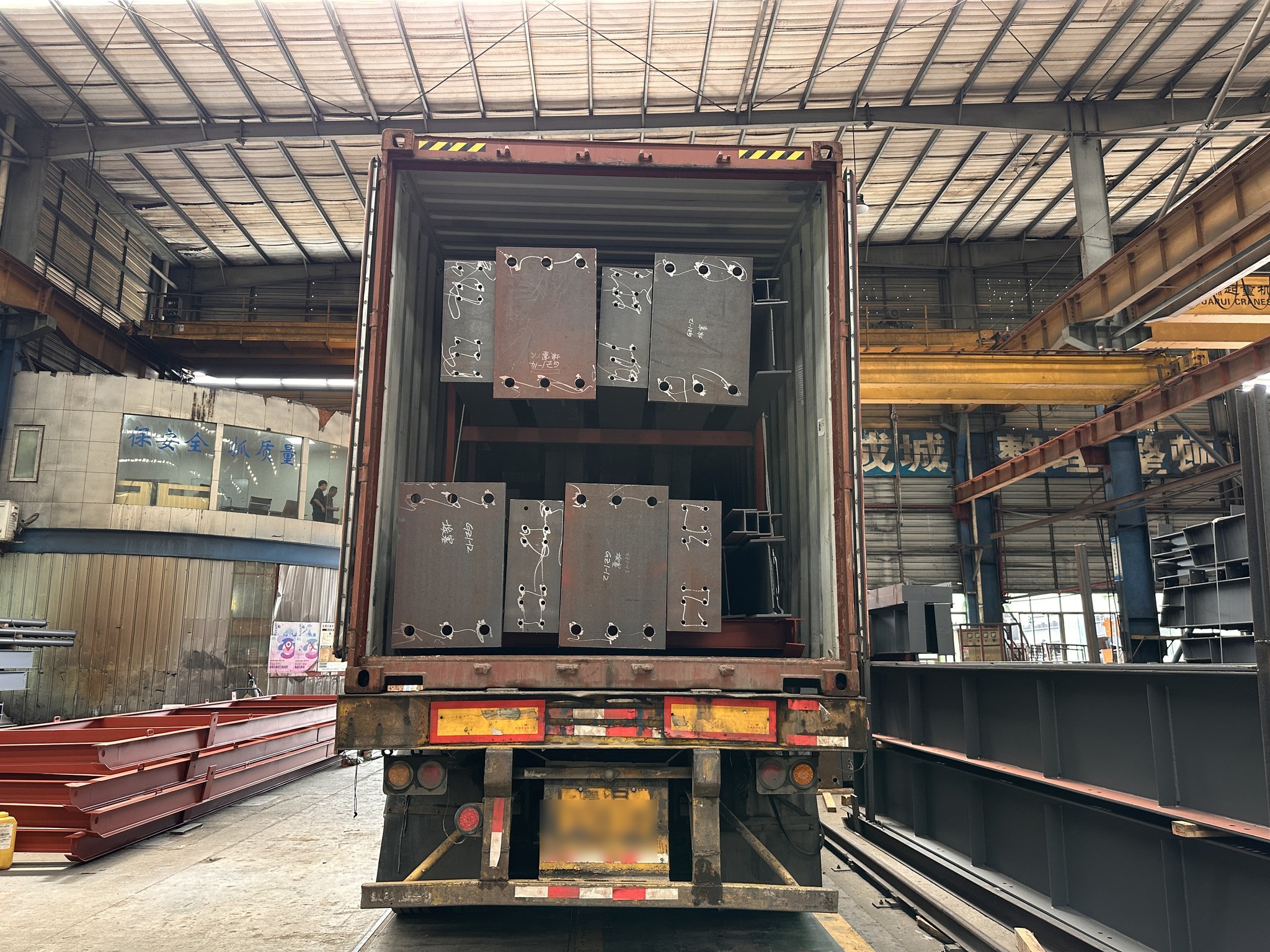
Packing, marking, loading and terminal handling sit between a steel price and a delivered price; check which of them the quotation actually covers.
Responsibility boundary
| Stage | ZhongSai scope | Buyer / local party scope |
|---|---|---|
| Quotation | State scope, weight basis, coating system, cladding list, trade term and validity | Provide drawings, loads, site conditions and required standards |
| Design coordination | Engineering coordination and detailing for the agreed scope | Local code interpretation, registered engineer approval |
| Fabrication and QC | Fabrication, inspection and documented quality records for the agreed level | Additional third-party inspection if required |
| Packing and export | Marking, packing, loading and export documentation for the agreed term | Import clearance, duty, destination charges |
| Site | Installation technical guidance | Foundations, erection labour, crane, site safety, permits |

Drawing approval freezes the scope. A quotation compared before drawings are approved is a comparison of assumptions.
Checklist before you compare
- Both quotations describe the same scope of supply
- Both state theoretical or actual weight, and the member breakdown
- Steel grades and mill certificate requirements are stated
- Coating system, DFT and application location are stated
- Cladding build-up, colour and accessory list are itemised
- Doors, windows and openings are itemised or shown as allowances
- Packing, marking and container quantity are stated
- Trade term, port, freight validity and unloading responsibility are clear
- Validity date, payment milestones and lead time are stated
- Excluded local costs are listed separately with local prices
FAQ
Why do two suppliers quote very different totals for the same building?
Usually because the scope, weight basis or coating and cladding specification differ, not because one is overpriced. Normalise all three before comparing.
Is a price per square metre reliable?
It can be a useful early indicator, but it cannot be compared without the tonnage, the cladding allowance and the accessory list behind it.
Should a quotation be based on theoretical or actual weight?
Both are used in the industry; the important point is that both offers use the same basis and the drawings are the reference. Theoretical weight is normally calculated from the member schedule.
Why is “painted” not enough in a quotation line?
Because a primer-only finish and a full coating system with a stated dry film thickness are different products with different durability and different cost.
Are anchor bolts included?
Often supplied with the steel package, but setting, alignment and grouting are site work. Confirm which part is in the price.
Is erection included in an export quotation?
Normally not. Erection labour, crane and site safety are local, and are quoted separately unless the contract says otherwise.
What documents should come with the quotation?
At minimum the scope description, weight breakdown, specification of coating and cladding, trade term, validity and payment terms. Certificates and packing lists should be named if they are included.
How long should I expect a quotation to stay valid?
It depends on the supplier, steel market and freight market; the date should be written on the offer rather than assumed. See why quotations expire.
Send your drawings for a comparable quotation
If you already have drawings or a member schedule, send them and we will quote on a stated weight basis, coating system, cladding list and trade term, so the offer can be compared line by line. If your drawings are not complete, send the building use, dimensions, loads, crane requirement and destination, and we will start from the design criteria.
If you are still preparing the enquiry, use the RFQ checklist and the import payment milestone guide to close the remaining gaps.