
Steel Structure Corrosion Protection & Coating Complete Guide
Everything you need to know about steel structure corrosion protection: surface preparation standards, coating systems, paint types, DFT requirements, and environment-specific recommendations.
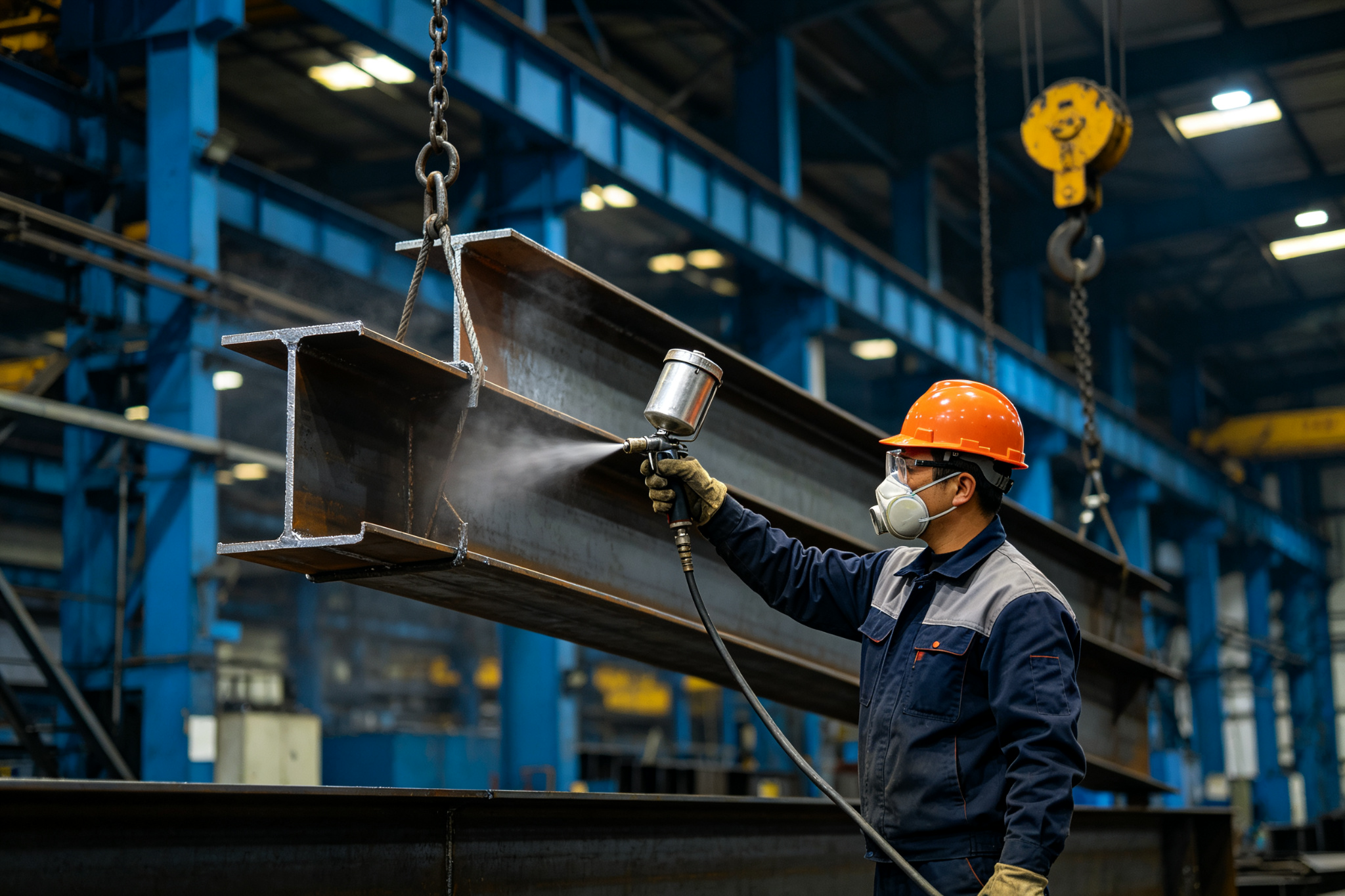
Steel is one of the strongest and most versatile building materials available, but it has one natural enemy: corrosion. Without proper protection, rust can compromise structural integrity, reduce lifespan, and lead to costly maintenance or replacement.
This guide covers everything buyers need to know about steel structure corrosion protection — from surface preparation to coating systems, standards, and how to specify the right protection for your project.
Direct Answer: What Determines Corrosion Protection Quality?
The effectiveness of corrosion protection depends on four factors, in order of importance:
| Rank | Factor | Impact | Typical Issue |
|---|---|---|---|
| 1 | Surface preparation | 40–50% | Poor adhesion, premature coating failure |
| 2 | Coating system selection | 25–30% | Wrong paint for environment, insufficient thickness |
| 3 | Application quality | 15–20% | Uneven coverage, pinholes, improper curing |
| 4 | Maintenance program | 5–10% | Neglected damage leads to spreading corrosion |
Key takeaway: Surface preparation is the most important factor. Even the best coating system will fail if applied to a poorly prepared surface.
Part 1: Understanding Steel Corrosion
How Rust Forms
Corrosion (rusting) is an electrochemical process that requires three elements:
- Anode: Area where metal dissolves (oxidation)
- Cathode: Area where oxygen and water react (reduction)
- Electrolyte: Water or moisture containing dissolved salts
When these three elements are present on steel surface, iron oxidizes to form iron oxide (rust). The process accelerates in the presence of:
- Salt (coastal environments, de-icing salts)
- High humidity
- Industrial pollutants (SO2, NOx)
- Elevated temperatures
- Poor ventilation
Corrosion Rates by Environment
| Environment Category | Typical Corrosion Rate (mm/year) | Examples |
|---|---|---|
| C1 (Very low) | < 0.001 | Heated buildings with clean air, offices |
| C2 (Low) | 0.001–0.013 | Rural areas, low humidity, clean air |
| C3 (Medium) | 0.013–0.062 | Urban/industrial areas, moderate humidity |
| C4 (High) | 0.062–0.145 | Coastal areas, industrial with SO2, high humidity |
| C5 (Very high) | 0.145–0.700 | Aggressive industrial, coastal with salt spray |
| CX (Extreme) | > 0.700 | Offshore, mining, chemical processing |
Based on ISO 12944 corrosion categories. These are bare steel rates — proper coating can reduce effective corrosion to near zero for decades.
Part 2: Surface Preparation
Why Surface Preparation Matters
Surface preparation is the foundation of any coating system. Its purpose is to:
- Remove mill scale, rust, and existing coatings
- Create a clean, rough surface for mechanical adhesion
- Remove contaminants (oil, grease, salts) that cause adhesion failure
Studies consistently show that surface preparation quality accounts for 40–50% of coating performance.
Common Surface Preparation Methods
| Method | Description | Typical Cleanliness | Best For |
|---|---|---|---|
| Shot blasting | Abrasive blast with steel shot/grit | Sa 2.5 / Sa 3 | New fabrication, highest quality |
| Sand blasting | Abrasive blast with silica sand | Sa 2.0–2.5 | General fabrication |
| Power tool cleaning | Wire brushes, grinding wheels | St 2 / St 3 | Maintenance, small areas |
| Hand tool cleaning | Manual wire brushes, scrapers | St 2 | Touch-up only |
| Acid pickling | Chemical removal of rust/mill scale | — | Continuous production lines |
Swedish Standard (SIS 055900) Cleanliness Grades
The most widely referenced standard for blast cleaning:
| Grade | Description | Visual Standard |
|---|---|---|
| Sa 1 | Light blast cleaning | Loose mill scale, rust, and coating removed |
| Sa 2 | Thorough blast cleaning | Most mill scale, rust, and coating removed |
| Sa 2.5 | Very thorough blast cleaning (near-white) | All visible rust, mill scale, and coating removed; only faint stains remain |
| Sa 3 | Blast cleaning to visually clean steel | Uniform metallic white appearance, no stains |
Industry recommendation for structural steel: Sa 2.5 is the standard minimum for most projects. Sa 3 is specified for extreme environments (C5/CX) or critical components.
Surface Roughness (Profile)
In addition to cleanliness, surface roughness (anchor profile) is critical:
- Typical range: 40–80 microns (1.5–3.0 mils)
- Too smooth: Poor mechanical adhesion
- Too rough: Peak rusting, coating too thin at peaks, increased paint consumption
- Measurement: Testex tape, digital profile gauge
Surface Contaminants to Remove
After blasting, the surface must be free of:
- Oil and grease (solvent wipe before blasting)
- Soluble salts (chlorides, sulfates — test with Bresle patch)
- Dust and abrasives (vacuum or air blow)
- Moisture (surface temperature > dew point + 3°C)
Part 3: Coating Systems
Typical 3-Coat System
The standard protective coating system for structural steel consists of three layers:
┌─────────────────────────────────┐
│  Topcoat (40–60 μm)            │  UV resistance, color, gloss
│  Polyurethane / Fluorocarbon    │
├─────────────────────────────────┤
│  Intermediate coat (60–100 μm) │  Build thickness, barrier protection
│  Epoxy (micaceous iron oxide)   │
├─────────────────────────────────┤
│  Primer (60–80 μm)              │  Corrosion inhibition, adhesion
│  Epoxy zinc-rich / Zinc phosphate│
├─────────────────────────────────┤
│  Steel substrate (Sa 2.5)       │
└─────────────────────────────────┘
Total DFT: 160–240 microns (6–9.5 mils) for standard environments
Primer Types
| Primer Type | Solids | DFT | Best For | Key Advantage |
|---|---|---|---|---|
| Epoxy zinc-rich | 60–80% | 60–80μm | C3–C5 environments | Cathodic protection (galvanic) |
| Epoxy zinc phosphate | 50–70% | 50–75μm | C2–C3, interior | Good adhesion, lower cost |
| Inorganic zinc silicate | 60–70% | 50–75μm | C4–C5, offshore | Excellent corrosion resistance, heat resistant |
| Shop primer (wash primer) | 10–20% | 15–25μm | Temporary protection | Fast drying, weld-through |
Zinc-rich primer explanation: Zinc particles are more electrochemically active than steel. When the coating is scratched, zinc corrodes sacrificially, protecting the underlying steel (cathodic protection). This is why zinc-rich primers are preferred for exterior and aggressive environments.
Intermediate Coat Types
| Type | Typical DFT | Purpose |
|---|---|---|
| Epoxy (high build) | 100–200μm | Barrier protection, thickness build |
| Epoxy MIO (micaceous iron oxide) | 80–150μm | Lamellar barrier, UV-stable undercoat |
| Epoxy glass flake | 200–500μm | Extreme barrier for immersion/chemical |
Topcoat Types
| Topcoat Type | Gloss Retention | Weathering | Best For |
|---|---|---|---|
| Polyurethane (PU) | Good (7–10 years) | Excellent | Exterior, C3–C4, general use |
| Acrylic polyurethane | Very good (10–15 years) | Excellent | High-end exterior, color stability |
| Fluorocarbon (PVDF) | Excellent (15–20+ years) | Superior | Coastal, C4–C5, premium projects |
| Epoxy (topcoat) | Poor (chalks) | Fair | Interior only, not UV resistant |
| Alkyd | Fair | Fair | Low-cost, interior/mild exterior |
Part 4: Coating Specifications by Environment
ISO 12944 Recommended Systems
| Corrosion Category | Recommended System | Total DFT | Expected Life to First Maintenance |
|---|---|---|---|
| C2 (Low) | 1-coat epoxy primer + 1-coat polyurethane | 120–160μm | 15–25 years |
| C3 (Medium) | Zinc-rich epoxy primer + epoxy intermediate + PU topcoat | 160–200μm | 15–25 years |
| C4 (High) | Zinc-rich epoxy primer + epoxy MIO intermediate + PU/fluorocarbon topcoat | 200–280μm | 15–25 years |
| C5 (Very high) | Inorganic zinc primer + epoxy intermediate + fluorocarbon topcoat | 280–400μm | 15–25 years |
| CX (Extreme) | Custom system, often thermal spray metal + sealing | 400–600μm | Project-specific |
“Expected life to first maintenance” per ISO 12944: High = 15–25 years. This is not the total lifespan of the coating — it is when first significant maintenance (touch-up/recoat) is expected.
Common Project Specifications
Standard Industrial Building (C3)
- Surface prep: Sa 2.5
- Primer: Epoxy zinc-rich, 70μm DFT
- Intermediate: Epoxy high-build, 80μm DFT
- Topcoat: Polyurethane, 50μm DFT
- Total: 200μm
- Colors: RAL 5015 (sky blue), RAL 7035 (light gray), RAL 9002 (gray white)
Coastal Warehouse (C4)
- Surface prep: Sa 2.5
- Primer: Epoxy zinc-rich, 80μm DFT
- Intermediate: Epoxy MIO, 100μm DFT
- Topcoat: Acrylic polyurethane or fluorocarbon, 60μm DFT
- Total: 240μm
Heavy Industrial / Chemical (C5)
- Surface prep: Sa 3 (near-white)
- Primer: Inorganic zinc silicate, 75μm DFT
- Intermediate: Epoxy glass flake, 200μm DFT
- Topcoat: Fluorocarbon, 60μm DFT
- Total: 335μm
Part 5: Hot-Dip Galvanizing
What Is Hot-Dip Galvanizing?
Hot-dip galvanizing (HDG) is a process where steel is immersed in molten zinc (~450°C), forming a metallurgically bonded zinc-iron alloy coating. It provides:
- Barrier protection: Zinc layer separates steel from environment
- Cathodic protection: Zinc corrodes sacrificially if scratched
Galvanizing Coating Thickness
| Steel Thickness | Minimum Coating (ISO 1461) | Typical Coating |
|---|---|---|
| < 1.5mm | 35μm (g/m²: 505) | 45–65μm |
| 1.5–3mm | 45μm (g/m²: 650) | 55–75μm |
| 3–6mm | 55μm (g/m²: 795) | 65–85μm |
| > 6mm | 85μm (g/m²: 1225) | 90–120μm |
Galvanizing vs. Paint Coating
| Factor | Hot-Dip Galvanizing | Paint Coating |
|---|---|---|
| Initial cost | Higher (per ton) | Lower |
| Life expectancy | 50+ years (rural), 20–40 years (coastal) | 15–25 years to first maintenance |
| Maintenance | Very low | Regular inspection/touch-up |
| Damage repair | Difficult (zinc-rich paint touch-up) | Easy (spot repair/recoat) |
| Color options | Gray only (can be painted over) | Unlimited colors |
| Coverage | Inside/outside, all surfaces including recesses | Edge coverage can be薄弱 |
| Best for | Transmission towers, guardrails, small components, C4+ environments | Buildings, color-coded structures, architectural applications |
Duplex System (Galvanizing + Paint)
For maximum protection in aggressive environments, a duplex system combines hot-dip galvanizing with a paint topcoat:
- Galvanizing provides cathodic protection
- Paint provides additional barrier and color
- Synergistic effect: coating life can be 1.5–2.3× the sum of individual systems
- Common for coastal, industrial, and infrastructure projects
Part 6: Coating Quality Control and Inspection
Pre-Application Checks
Before coating begins, verify:
- Surface preparation grade: Visual comparison with ISO 8501-1 photos / Sa grade
- Surface profile: Testex tape or digital gauge (40–80μm target)
- Surface cleanliness: Solvent salts test (Bresle), dust rating (ISO 8502-3)
- Environmental conditions:
- Steel temperature: > 3°C above dew point
- Relative humidity: < 85% (some products < 80%)
- Air temperature: 5–40°C (product-specific)
- Paint material: Batch numbers, shelf life, mixing ratio, induction time
During Application
- Wet film thickness (WFT): Measured immediately after application with WFT gauge
- Dry film thickness (DFT): Measured after curing with magnetic/eddy current gauge
- Standard: 80% of readings ≥ specified, minimum ≥ 80% of specified
- Take readings: 1 reading per 5–10 m², minimum 5 readings per component
- Holiday detection: For immersion service, spark test for pinholes
- Adhesion test: Cross-cut (ISO 2409) or pull-off (ISO 4624)
Post-Application
- Visual inspection: Uniform coverage, no runs/sags/pinholes, correct color
- DFT report: Documented readings for each component/batch
- Cure verification: Hardness test, solvent rub test (MEK double rubs)
- Coating report: Complete documentation for project handover
Common Coating Defects
| Defect | Cause | Prevention |
|---|---|---|
| Pinholes | Trapped solvent, too thick application, porous surface | Proper viscosity, correct spray technique, adequate flash time |
| Runs/sags | Too much paint, too thin viscosity, poor technique | Correct WFT, proper spray distance, environmental control |
| Orange peel | Incorrect viscosity, wrong nozzle, poor atomization | Proper thinning, correct nozzle size, adequate air pressure |
| Adhesion failure | Poor surface prep, contamination, incompatible coats | Sa 2.5 prep, solvent clean, correct coating system |
| Blistering | Solvent entrapment, moisture under coating, osmotic pressure | Proper flash time, dry surface, soluble salt removal |
| Chalking | UV degradation of epoxy topcoat, weathering | Use PU/fluorocarbon topcoat for exterior |
| Rust bleeding | Coating damage, insufficient thickness, poor prep | Touch-up promptly, adequate DFT, proper prep |
Part 7: Buyer’s Guide to Specifying Coating
Questions to Ask Your Supplier
- What surface preparation standard is used? (Should be Sa 2.5 minimum for exterior)
- What is the total DFT of the coating system? (Get per-layer breakdown)
- Can you provide DFT measurement reports? (A reputable supplier will)
- What paint brands and products are used? (International, Jotun, Hempel, PPG, Kansai, etc.)
- What is the coating system designed for? (Which corrosion category C2–C5)
- How is coating quality inspected? (In-house QC, third-party inspection available)
- What is the expected coating lifespan? (To first maintenance, not total lifespan)
- Can you provide coating material certificates? (Batch numbers, product data sheets)
- What touch-up paint is provided? (Same system, for shipping/installation damage)
- Is hot-dip galvanizing available? (For C4+ environments or specific components)
Red Flags in Coating Specifications
- ❌ Only “painted” or “anti-corrosion paint” with no specification
- ❌ Single-coat system for exterior use
- ❌ Total DFT below 100μm for exterior
- ❌ No surface preparation standard mentioned
- ❌ Epoxy topcoat for exterior (will chalk/fade)
- ❌ No DFT reports available
- ❌ “Guaranteed 20 years” without specifying conditions
- ❌ Unknown/no-name paint products
Coating Cost Considerations
Coating typically represents 8–15% of total steel structure cost. While it may be tempting to reduce coating to save money, this is a false economy:
- A 10% saving on coating can lead to 50–100% higher maintenance costs over 20 years
- Premature coating failure requires abrasive blast and full recoat (expensive, disruptive)
- Corrosion that reaches structural steel can compromise safety and require component replacement
Recommendation: Invest in a proper coating system upfront. It is one of the most cost-effective decisions for long-term building value.
Part 8: Maintenance and Repair
Regular Inspection Schedule
| Building Age | Inspection Frequency | Focus Areas |
|---|---|---|
| 0–5 years | Every 2 years | General condition, shipping/installation damage |
| 5–10 years | Annual | Coating degradation, fastener areas, base plates |
| 10–15 years | 6–12 months | Chalking, fading, blistering, rust spots |
| 15+ years | Every 6 months | Comprehensive assessment, recoat planning |
Touch-Up Procedure
For small areas of coating damage (≤ 0.5 m²):
- Clean: Remove loose coating, rust, and contaminants
- Prepare: Power tool clean to St 3, feather edges
- Prime: Apply 1–2 coats of compatible primer
- Topcoat: Apply 1–2 coats of matching topcoat
- Blend: Feather edges to blend with surrounding coating
Full Recoat
When coating degradation exceeds 20–30% of surface area:
- Assess: Determine extent of corrosion, coating system remaining
- Contain: Protect surrounding areas, collect debris
- Remove: Abrasive blast to Sa 2.5 (or power tool if blasting not feasible)
- Repair: Address any steel section loss (weld reinforcement, replacement)
- Repaint: Apply full 3-coat system per specification
- Document: DFT reports, coating certificates, photos
Conclusion
Corrosion protection is one of the most important — and often most overlooked — aspects of steel structure procurement. The key takeaways:
- Surface preparation is everything: Sa 2.5 minimum, proper profile, clean surface
- Match the system to the environment: C2 needs less, C5 needs more — don’t over-spec or under-spec
- Three-coat system is standard: Zinc-rich primer + epoxy intermediate + PU/fluorocarbon topcoat
- DFT matters: Get per-layer specifications and measurement reports
- Invest upfront: Proper coating saves 2–5× in maintenance costs over the building’s life
- Maintain regularly: Inspect and touch-up to extend coating life significantly
- Ask for documentation: DFT reports, material certificates, inspection records
A well-protected steel structure can last 50–100+ years. A poorly protected one may need major coating work in 5–10 years. The difference is in the specification, execution, and maintenance.
Have drawings or project requirements? Send your project location, building use, and available drawings. ZhongSai can recommend the appropriate corrosion protection system based on your environment and provide detailed coating specifications with DFT reports.