Why this matters: The steel structure industry has thousands of "manufacturers" in China, but an estimated 60-70% are actually trading companies with no production facility. Working with a real factory saves 15-30% cost, ensures quality control, and provides direct technical support. This checklist helps you identify real manufacturers and avoid costly mistakes.
1. Company Legal Verification (10 Points)
1.1 Business License Check
- Request official business license (营业执照) with official red seal
- Verify company name matches exactly what they use in communication
- Check registration date — companies under 2 years old have limited track record
- Check registered capital — should be at least RMB 5 million ($700k) for manufacturing
- Verify legal representative name — cross-check with other documents
1.2 Business Scope Analysis
- Critical: Business scope must include "钢结构制造" (steel structure manufacturing) or "金属结构制造" (metal structure manufacturing)
- If scope only shows "进出口贸易" (import/export trading) or "销售" (sales) — it's a trading company
- Check if "生产" (production) or "制造" (manufacturing) appears in scope
- Verify company is registered in an industrial zone, not a commercial office building
1.3 Online Verification Tools
- Qichacha.com or Tianyancha.com — Chinese company registration databases (free basic info)
- Check for legal disputes,行政处罚 (administrative penalties), or abnormal operation status
- Verify company has annual reports filed (indicates active, legitimate operation)
- Check if company has actual tax payment records (manufacturers pay VAT on production)
2. Factory Capability Verification (15 Points)
2.1 Physical Factory Verification
- Video factory tour: Request live video call (WeChat/WhatsApp) walking through entire factory — real factories agree immediately, trading companies make excuses
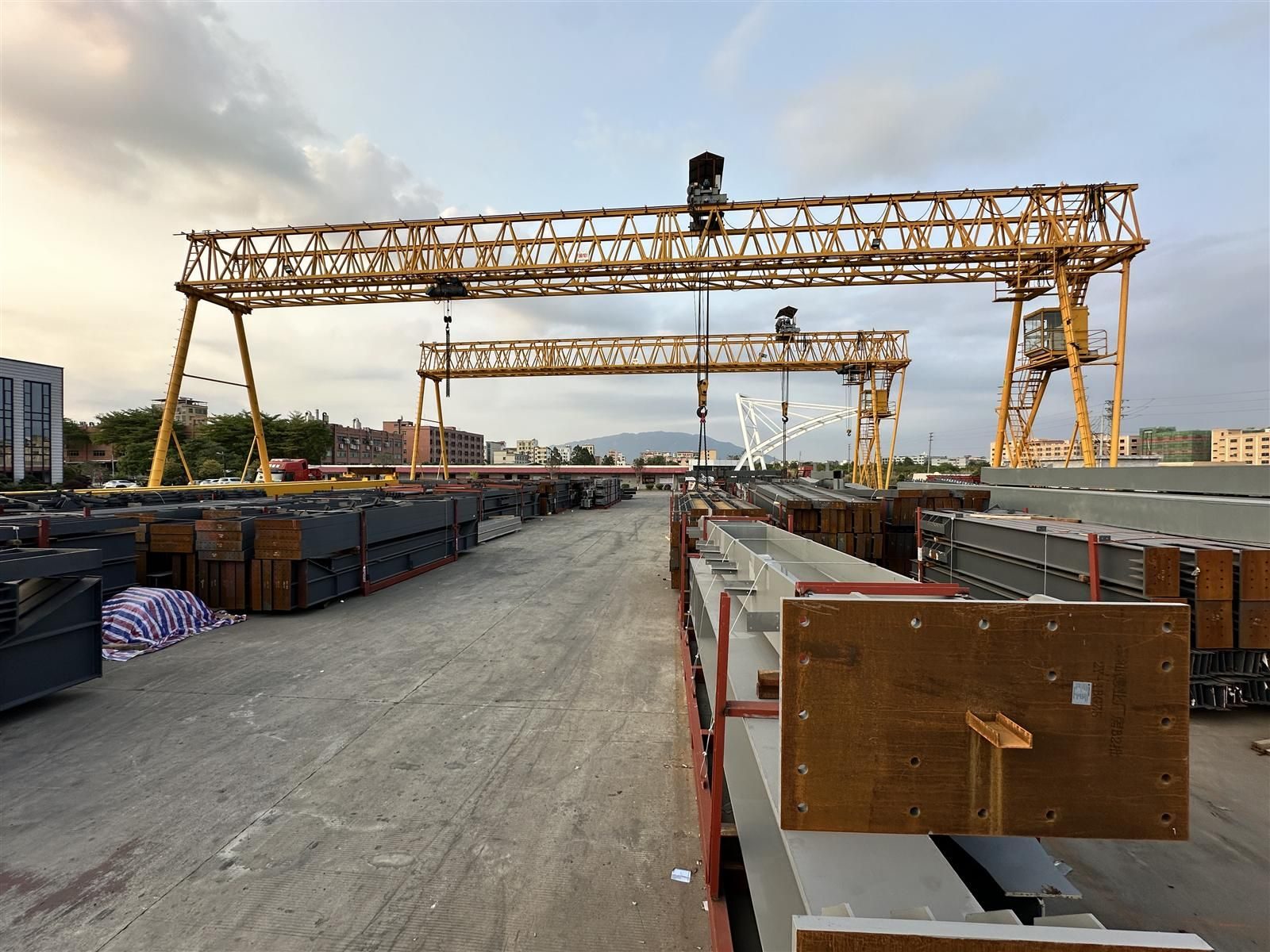
- Verify factory address via Google Maps or Baidu Maps satellite view — look for: factory buildings, overhead cranes visible, raw material steel stacks, finished product yards, parking for worker vehicles
- Check factory size — real steel structure factories need minimum 5,000 m² production area (most are 10,000-50,000 m²)
- Look for company name signage at factory entrance (trading companies can't show this)
- Count workers visible during video tour — real factories have 30-200+ production workers on shift
2.2 Production Equipment Check
- CNC cutting machines (plasma or flame) — essential for accurate fabrication
- Drilling machines (multi-axis CNC drill lines for beams and columns)
- Welding equipment — should have submerged arc welding (SAW) for beam welding, not just manual welding
- Shot blasting / sand blasting room for surface preparation
- Painting booth or spray area with proper ventilation
- Overhead cranes in production area (5-30 ton capacity) for material handling
- Raw material inventory — should see stacks of H-beams, plates, tubes with mill tags
- Finished product inventory — fabricated members ready for shipment with project markings
2.3 Production Capacity
- Ask for monthly production capacity in tons — real factories: 500-5,000 tons/month
- Verify with factory size and equipment (10,000 m² factory ≈ 1,000-2,000 tons/month capacity)
- Ask current production load — reputable factories are typically 60-90% booked, not 100% (can't deliver) or 0% (no customers)
- Check if they have experience with projects of your size (ask for similar project references)
3. Technical Capability Verification (10 Points)
3.1 Engineering Team
- Ask how many in-house structural engineers they employ (real factories: 3-20+ engineers)
- What design software do they use? (Correct answers: SAP2000, ETABS, Tekla Structures, STAAD.Pro, 3D3S — if they only say AutoCAD, they outsource engineering)
- Can they provide structural calculation report for your project? (Real factories produce in-house, trading companies outsource with delays)
- Ask engineer qualifications — should have registered structural engineer (注册结构工程师) or similar
- Test with technical question: "What wind load do you use for [your city]?" — real engineers know local codes or can calculate
3.2 Design Standards Knowledge
- Chinese standards: GB 50017 (steel structure design), GB 50009 (load code), GB 50661 (welding)
- American standards: AISC 360, AWS D1.1, ASTM A6/A572/A36
- European standards: EN 1993 (Eurocode 3), EN ISO 3834 (welding quality)
- Australian standards: AS 4100, AS/NZS 3678
- Ask which standards they have experience with — real factories exporting globally know multiple standards
3.3 Drawing Capability
- Request a sample fabrication drawing (shop drawing) from a past project — real factories produce detailed drawings with part numbers, dimensions, weld symbols, material specs
- Check if they use Tekla Structures for 3D modeling (industry standard for steel fabrication)
- Ask if they can provide CNC files for automated production (indicates in-house detailing)
- Verify drawing revision control — professional factories have drawing numbering and revision tracking
4. Quality Control System (10 Points)
4.1 Certifications
- ISO 9001:2015 — must be valid, check expiry date and certification body (verify with issuer, many display fake certificates)
- ISO 14001 Environmental Management (good indicator of professional operation)
- ISO 45001 Occupational Health & Safety (optional but positive)
- CE certification (for European market projects — check if self-declared or notified body certified)
- CIDB registration (for Malaysia projects)
- Other market-specific certifications as needed for your country
4.2 Material Quality Control
- Do they provide mill test certificates (MTC) per EN 10204 3.1 for all steel materials? (Essential — if they can't, material quality is unverifiable)
- Do they inspect incoming materials with material test reports (MTR) verification?
- Can they trace material heat numbers through production? (Quality factories track heat numbers on every piece)
- Do they have material storage system (separated by grade, size, project)?
- Ask: "What steel mills do you source from?" (Reputable: Baosteel, Ansteel, Wuhan Iron & Steel — avoid unknown small mills)
4.3 Production Quality Control
- Welding procedure specifications (WPS) — do they have documented WPS for each weld type?
- Welder qualification — do welders have certification (AWS CWI, ISO 9606, or Chinese 焊工证)?
- Non-destructive testing (NDT) — do they have in-house UT (ultrasonic testing) capability, or use third-party?
- Dimensional inspection — do they have final inspection with dimensional check reports?
- Surface treatment — shot blasting grade (Sa2.5 standard), paint thickness measurement (DFT gauge)
- Final inspection before shipment — ask for inspection report format
- Third-party inspection — are they willing to accept SGS, BV, or TUV inspection before shipment? (Reputable factories agree, low-quality refuse)
5. Export Experience and References (5 Points)
5.1 Export Track Record
- How many years of export experience? (Look for 5+ years — our company has 15+ years)
- How many countries have they exported to? (Experienced exporters: 30+ countries)
- Can they provide bill of lading copies from past shipments (with sensitive info redacted)?
- Do they have experience with your specific destination country's import requirements?
- Ask for container loading photos from past projects (real factories have actual loading photos, not stock images)
5.2 Client References
- Request 2-3 client references in your region or similar project type
- Contact references directly — ask about: quality, delivery time, communication, after-sales support, would they order again?
- Check online reviews — Google reviews, Alibaba reviews (if they have store), industry forum mentions
- Be cautious if references are only from countries far from yours or very old projects
6. Red Flags — Warning Signs (15 Points)
If you see 3+ of these red flags, walk away. The risk of quality failure, delays, or fraud is too high.
- Price 30%+ below market average — If everyone quotes $80-100/m² and one quotes $50/m², they're cutting quality (thinner steel, inferior materials, no engineering) or it's a scam
- Refuses video factory tour — Any excuse ("camera broken", "manager not here", "factory busy") means they have no factory to show
- Only stock photos on website — No real factory, production, or project photos means trading company or fake operation
- Business license shows only trading scope — No manufacturing in business scope = no factory
- Factory address is office building — Real factories are in industrial zones, not CBD office towers
- 100% upfront payment demanded — Standard is 30% deposit + 70% before shipment. 100% upfront = high fraud risk
- Payment to personal bank account — Legitimate companies receive payment to corporate account only. Personal account = tax evasion or scam
- Cannot provide mill test certificates — No MTC = no material quality verification = risk of inferior steel
- Cannot provide structural calculations — No engineering capability = design may be unsafe or overdesigned (wasting your money)
- Company registered under 1 year — No track record, may disappear after deposit
- No verifiable client references — Can't provide contacts, or references don't respond
- Refuses third-party inspection — If they won't allow SGS/BV inspection before shipment, they're hiding quality problems
- Vague answers to technical questions — If salesperson can't answer basic technical questions or always "needs to ask engineer", there may be no in-house technical team
- Unrealistic delivery promises — "2 weeks for any size project" = they don't understand production scheduling or will rush with quality cutting
- No contract or vague contract terms — Reputable factories provide detailed contracts with specifications, tolerances, delivery terms, penalty clauses. Vague contracts = no accountability
7. Recommended Verification Process (Step by Step)
- Initial screening (Day 1-3): Collect 5-10 potential suppliers, check websites, request quotations, verify business licenses
- Technical screening (Day 4-7): Ask technical questions, request sample drawings, verify engineering capability, check certifications
- Factory verification (Day 8-10): Video factory tour, satellite map check, equipment verification, worker count
- Reference check (Day 11-14): Contact 2-3 client references, check online reviews, verify export history
- Sample order or small trial (Optional): For large projects, consider small trial order first to test quality and communication
- Factory visit (Highly recommended for projects over $100k): Visit factory in person, meet engineers, inspect production, verify quality control firsthand
- Final selection and contract: Choose based on total value (not just lowest price), sign detailed contract with clear specifications and quality standards
8. ZhongSai Steel Structure — Our Verification Credentials
We invite you to verify us using every point on this checklist:
- Legal: Shenzhen ZhongSai Steel Structure Import and Export Co., Ltd. + manufacturing entities in Dongguan/Huizhou, 15+ years export history
- Factory: 100,000 m² production area across two facilities, 300+ workers, 100,000 tons annual capacity — video tour available anytime
- Engineering: 15+ in-house structural engineers, Tekla/SAP2000/ETABS/3D3S, full calculation reports provided
- Quality: ISO 9001:2015 certified, EN 10204 3.1 mill certificates, SGS/BV third-party inspection welcome
- Export: 60+ countries, 700+ containers shipped, verifiable references available on request
- Transparency: We encourage factory visits, video calls at any time, and full production progress updates with photos
Verify Us Today — No Obligation
Request a video factory tour, technical consultation, or detailed quotation. We're confident we'll pass every check on this list.
Request Factory Verification